Filmoplast Tape® This is a specialised conservation material used for the repair, reinforcement, and protection of paper, documents, and book bindings. It differs from ordinary adhesive tapes primarily in its chemical composition: it is acid-free. This means that it does not cause yellowing or degradation of the substrate over decades.
The Filmoplast® product line includes several variations differing in carrier, thickness, transparency and purpose. Each type corresponds to different conservation needs.
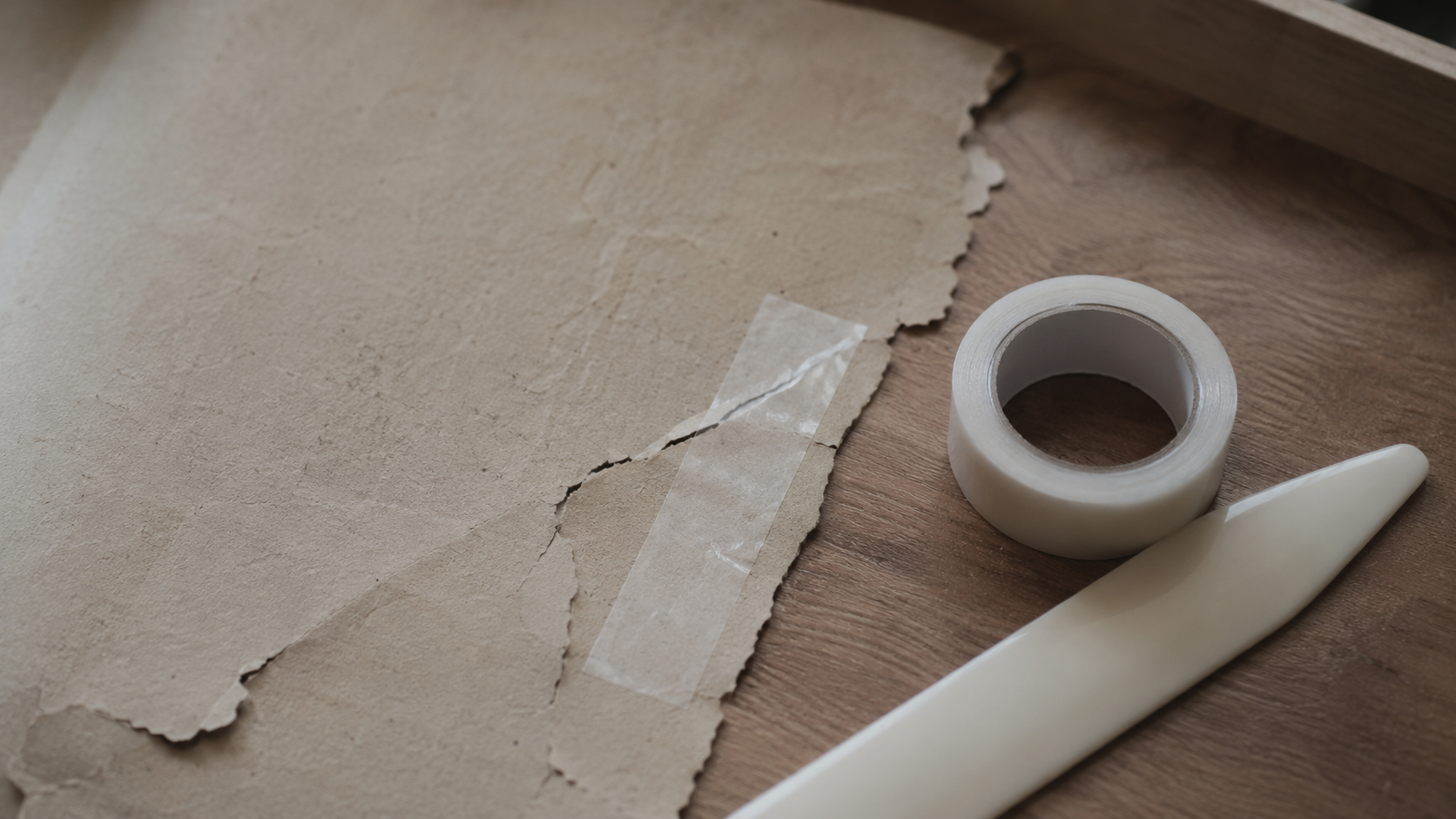
Filmoplast® P is paper tape made from short-fibre, acid-free paper. It is self-adhesive It is transparent when applied to a substrate. It is used for repairing tears, mending ripped pages, and securing damaged document edges. Its thin structure means it barely alters the appearance of the repaired area after application.
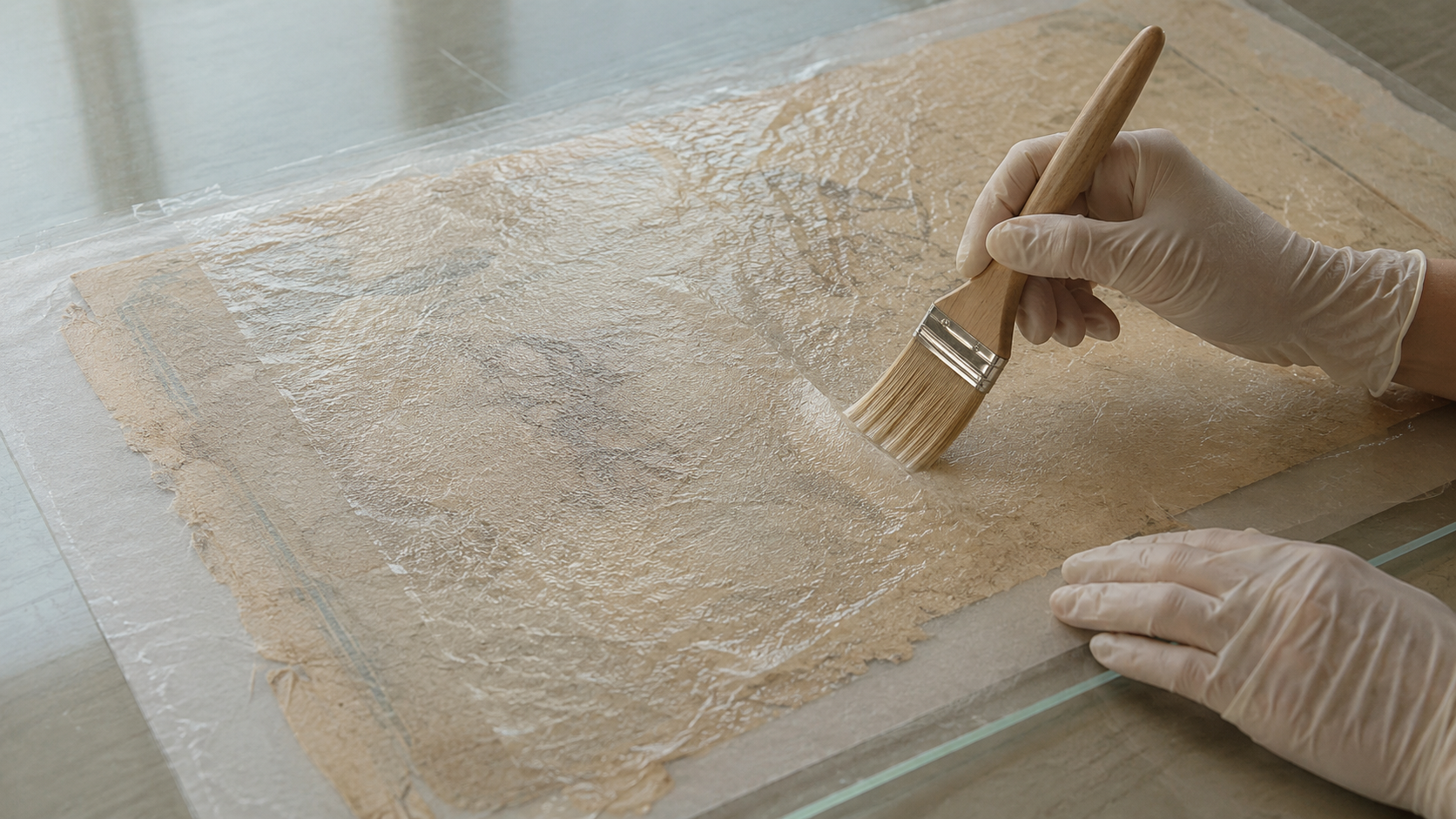
Filmoplast® R is a specialist, extremely thin Japanese tissue paper coated with a heat-activated adhesive. Unlike other variants, it is not a cold-adhesive tape – it requires the use of high temperature (e.g. a special tacking iron or conservation iron set to approx. 100°C-115°C), which activates the adhesive. It is used for very discreet repairs and for full-surface strengthening (laminating) of damaged sheets.
Filmoplast® P90 is a version made with long-fibre paper, making it more mechanically durable than Filmoplast® P. The long fibres create a more cohesive network that better transfers stress. It is ideal for repairing areas exposed to repeated bending, such as the spines of cards or at the binding. The tape is white and opaque, recommended for use where it will not obscure text.
Filmoplast® SH is a 170 µm (micrometre) thick cotton tape, made from fine-fibre white cotton. It is acid-free and tear-resistant. It is intended for reinforcing the inside of spines, joining the block to the cover, and other tasks requiring high mechanical strength while maintaining elasticity.
Filmoplast® T is a textile tape used for reinforcing the outside of book spines, joining the block to the cover, and repairing damaged bindings. The textile carrier ensures high tensile and flexural strength. This is important for frequently used bindings.
Filmoplast® tapes are used in several areas of conservation and bookbinding.
In libraries and archives, they are primarily used for the ongoing repair of collections:
When archiving documents, the priority is to maintain the readability and integrity of the document, which is why variants with high transparency are used.
In bookbinding workshops, textile and cotton tapes are used for constructing and repairing bindings. Filmoplast® T and SH are used for backlining, which is the reinforcing of the spine of a book block before binding, and for joining the book block to the cover in softcover and hardcover bindings.
In the conservation of maps, posters, and prints, paper tapes allow tears to be repaired without interfering with the print or drawing layer. Thin, transparent tape applied from pages reversed It is practically invisible from the front.
When archiving private documents such as old photographs, letters or manuscripts, Filmoplast tapes® enable the stabilisation of damage without the risk of further chemical degradation.
The choice of the correct variant depends on factors such as:
For the repair of thin papers, documents with text and illustrations, Filmoplast® P is best suited due to its high transparency and minimal thickness. The repair will be almost invisible, especially when the tape is applied to its reverse side.
For the repair of thicker papers, album boards, or documents exposed to mechanical stress, Filmoplast® P90 is a better choice. The long-fibre structure ensures greater strength with similar transparency.
Filmoplast® SH and T are intended for use in spines and bindings where flexibility and resistance to repeated folding are required. Filmoplast® SH is used inside the binding, while Filmoplast® T is used externally or for constructing new joints.
When choosing, it's also worth considering the width of the tape. Narrow variants are suitable for precise tear repairs, while wider ones are good for reinforcing spines and edges.
The surface must be clean and dry. Dust, grease, and moisture weaken the adhesive's adhesion. When it comes to archival documents, solvent-based cleaning agents should not be used, as they can damage the paper or ink. A gentle removal of loose dirt with a soft brush is sufficient.
The torn edges should be aligned as accurately as possible before applying the tape. For tears with missing material, the edges should be fitted together to minimise the gap. If the paper is creased or curled, it is advisable to lightly moisten and press it flat before repairing, ensuring it is completely dry before applying the tape.
When repairing book spines, old glue residue and damaged sections of binding material are removed. The surface should be flat and stable, with no loose fibres.
Correctly applying tape requires precision and patience. Rushing leads to mistakes that cannot be easily fixed.
The first step is to measure out the correct length of tape. The tape should be cut with a few millimetres of excess on each side of the area to be repaired. A piece that is too short will not provide sufficient adhesion, while one that is too long will be visible and may hinder further work.
Peel the tape off the backing paper slowly, holding it by the edge. With thin paper variants, be careful not to stretch or crease it before application.
Application begins at one end of the repair area. The tape is applied to the substrate and gradually pressed along its entire length, avoiding the formation of bubbles. When repairing tears, the tape is applied centrally over the gap, so that it covers both edges evenly.
After application, the tape is pressed through a clean sheet of paper or film using a smooth tool, such as a plastic spatula. Pressing through a protective layer prevents damage to the tape surface and the substrate.
The repaired area should be pressed under a bookbinding press or heavy books for a few hours. This ensures even adhesion of the glue over the entire surface.
Yes, Filmoplast® tapes are one of the standard materials used when repairing books and archival materials. Their acid-free composition and chemical stability meet the requirements placed on conservation materials by libraries and archives.
Different variants are used in book repair depending on the location and nature of the damage. Pages are repaired with paper tapes, and spines and covers with textile or cotton tapes. It is possible to combine several variants within a single repair.
With archival materials, the reversibility of intervention is paramount. Some Filmoplast® variants can be removed using appropriate solvents without damaging the substrate or with a steam scalpel, although this is not straightforward. This aligns with the principle of minimal intervention in conservation.
Filmoplast® tapes are acid-free, meaning they will not cause yellowing or degradation of paper over the long term.
Filmoplast® P is often used for repairing tears and mounting loose cards.
Filmoplast® P90 book repair tape is used in areas subject to bending and mechanical stress, such as on the spines of pages or covers. It is also ideal for creating Japanese hinges (mounting photographs in mount board).
Filmoplast® SH and Filmoplast® T tapes are primarily used for reinforcing spines and joining the block to the cover.
The surface should be clean, dry and free from dust and loose debris.