Washi paper has accompanied Japanese culture for over thirteen centuries. For centuries, it has served as a medium for calligraphy, a base for woodblock prints, and a material for making everyday objects. Discover the most important information about it.
The word comes from the Japanese language: wa (wa) means Japan, and shi (paper) paper. Term washi however, it was only created during the Meiji period (1868–1912) to distinguish traditional Japanese paper from Western machine-made paper (foster child), which began to be imported en masse to Japan. Although the production technology itself has a history of over 1,300 years, the modern name is much younger. Today, the term „washi” encompasses both traditionally handmade papers and some machine-made papers, so the name itself is no longer a guarantee of a specific quality or manufacturing technique.
Washi differs from European paper primarily in its raw material and production technique. European handmade paper was made mainly from linen and cotton rags. Washi is produced primarily from kozo fibres (Broussonetia papyrifera), mitsumata (Edgeworthia chrysantha) and gampi (Diplomorpha sikokiana). Of greatest importance in conservation is kozo, the fibres of which reach approximately 10 mm in length and provide the paper with exceptional mechanical strength.
Kozoin fibres are particularly valued by conservators: long, flexible and mechanically durable, they form a network that, once dried, retains its integrity even upon repeated moistening and drying. This is a property that many European papers do not possess to the same degree.
Conservators reach for washi because the material meets several requirements at once: it is thin yet durable; it absorbs conservation adhesives evenly; it does not distort the substrate; and it remains flexible after drying. None of these attributes is accidental. They stem directly from the traditional production technology, which for centuries was perfected with a focus on durability rather than mass production.
Paper arrived in Japan from China probably in the 6th century AD, via Korea. Japanese artisans quickly adapted the Chinese technique to local raw materials and climatic conditions, creating a distinct manufacturing tradition. The first records of Japanese paper production date from the early 8th century. This marks the lower limit of a tradition with over 1,300 years of continuity.
For centuries, washi fulfilled functions reaching far beyond writing. It was used for making clothing, lamps, umbrellas, interior architecture elements and ritual objects. Japanese Buddhist monasteries and imperial courts were the main recipients of the finest grades. Craftsmen from individual regions developed their own recipes and techniques. This led to the creation of hundreds of varieties differing in weight, texture, absorbency and colour.
In 2014, UNESCO added the tradition of hand-crafting washi paper to the Representative List of the Intangible Cultural Heritage of Humanity. The inscription covered three traditions: Sekishu-Banshi (Shimane Prefecture), Hon-minoshi (Gifu Prefecture) and Hosokawa-shi (Saitama Prefecture). In 2025, the inscription was extended to include the Echizen Torinoko Ganpi tradition from Fukui Prefecture.
The rationale emphasised fidelity to the original technology as the key reason for the distinction. This was not an honorary entry for a fading craft, but recognition of a living practice that still produces material of documented quality.
Inscription on the UNESCO list had practical consequences for the conservation market. It increased interest in washi outside Japan, facilitated access to information on individual types, and contributed to the standardisation of nomenclature used by suppliers of conservation materials.
One of the most important events in the history of modern conservation was the 1966 Florence flood. The inundation of the Biblioteca Nazionale Centrale di Firenze and its vast collections of historical books led to the search for new methods of saving paper. It was then that Western conservators became widely acquainted with the properties of traditional Japanese washi. The experience gained during the rescue operation made this paper a standard material currently used in libraries, museums and archives worldwide.
Traditional washi production takes place in several stages, each of which influences the final properties of the material. Understanding this process allows conservators to consciously select types for specific applications.
The bast of mulberry, mitsumata or gampi is cooked in a mild alkaline solution, traditionally prepared from wood ash or sodium carbonate (soda ash). This process makes it possible to remove lignin and some of the accompanying substances without excessively damaging the cellulose fibers and hemicellulose, which increases the strength of the finished paper.
Cooking removes lignins and other substances that over time cause paper to yellow and become brittle. Primarily cellulose fibres remain, along with a portion of hemicellulose, which increases the strength of the finished paper. Water quality matters here: traditional Japanese paper mills were located by mountain streams, whose water is soft and free of minerals that disrupt the fibre structure.
The next stage is beating the fibres. The cleaned fibres are mechanically beaten to separate them into individual elements without shortening them. This distinguishes washi from industrial paper, in which the fibres are ground and shortened to achieve a smooth surface. The long, unshortened washi fibres form a high tensile and tear strength network once the sheet is formed.
Sheet formation is carried out using the *nagashizuki* or *tamezuki* method. In the method nagashizuki, characteristic of Japanese tradition, the craftsperson repeatedly scoops the fibre suspension onto a bamboo sieve and performs characteristic rocking motions in all directions. The excess suspension is partially poured back into the vat, which makes it possible to remove coarser fibre fractions and evenly arrange the remaining fibres within the spatial structure. Thanks to this, the paper retains exceptional strength at a very low basis weight.
Added to the suspension black – natural plant mucilage obtained primarily from tororo-aoi roots (Abelmoschus manihot, formerly Hibiscus manihotIn some regions, they also use Hydrangea paniculata. Neri is not an adhesive, but a suspension viscosity-modifying agent, which keeps the long fibres evenly dispersed during sheet formation by the method nagashizuki.
It slows down the settling of fibres and enables precise control over the thickness of the sheet. The result is paper with a random, three-dimensional fibre arrangement, which is stronger than paper with parallel fibres.
After forming, the sheets are traditionally dried on wooden boards, which allows for the slow evaporation of water and preserves the natural elasticity of the fibres. Modern production also utilises heated metal plates or drying cylinders, but this process can increase internal stresses in the fibres and impair the properties of the paper from the point of view of artefact conservation.
A finished sheet of washi paper typically has a substance ranging from a few to several dozen grams per square metre. This makes it one of the thinnest papers used in conservation.
Washi began to be widely used in European conservation studios after the catastrophic flood in Florence in 1966. The inundation of the Biblioteca Nazionale Centrale di Firenze and hundreds of thousands of historical documents revealed the limitations of the repair methods used at the time. Assistance provided by Japanese specialists and supplies of traditional washi paper demonstrated its exceptional strength and durability. This event is considered a watershed moment for the popularisation of Japanese paper in global conservation.
Primary uses of washi in conservation include:
In each of these applications, washi works well for similar reasons. The thin sheet does not add significant bulk to the object. This is essential when conserving delicate miniatures or watercolours.
It works consistently with adhesives used in conservation, primarily with highly purified wheat starch paste, which is considered the fundamental conservation binder. Methylcellulose is also used in conservation, although it typically provides lower mechanical bond strength than traditional starch paste.
This allows you to achieve a predictable bonding effect without the risk of over-saturation. Once dry, it remains flexible and does not restrict the natural movement of the substrate during humidity changes.
Conservators also value the reversibility of repairs made using washi. Paper adhered with traditional starch paste can safely be separated from the original after years of controlled humidification. This fulfils one of the fundamental principles of modern conservation, according to which any intervention should be reversible without damaging the artefact.
This is one of the fundamental requirements of conservation ethics: every intervention should be reversible so that future generations can correct it or replace it with a better method.
Washi is used today as a standard material in conservation in many cultural institutions worldwide. National libraries, state archives and museums have developed their own procedures for its application, tailored to the specific nature of their collections.
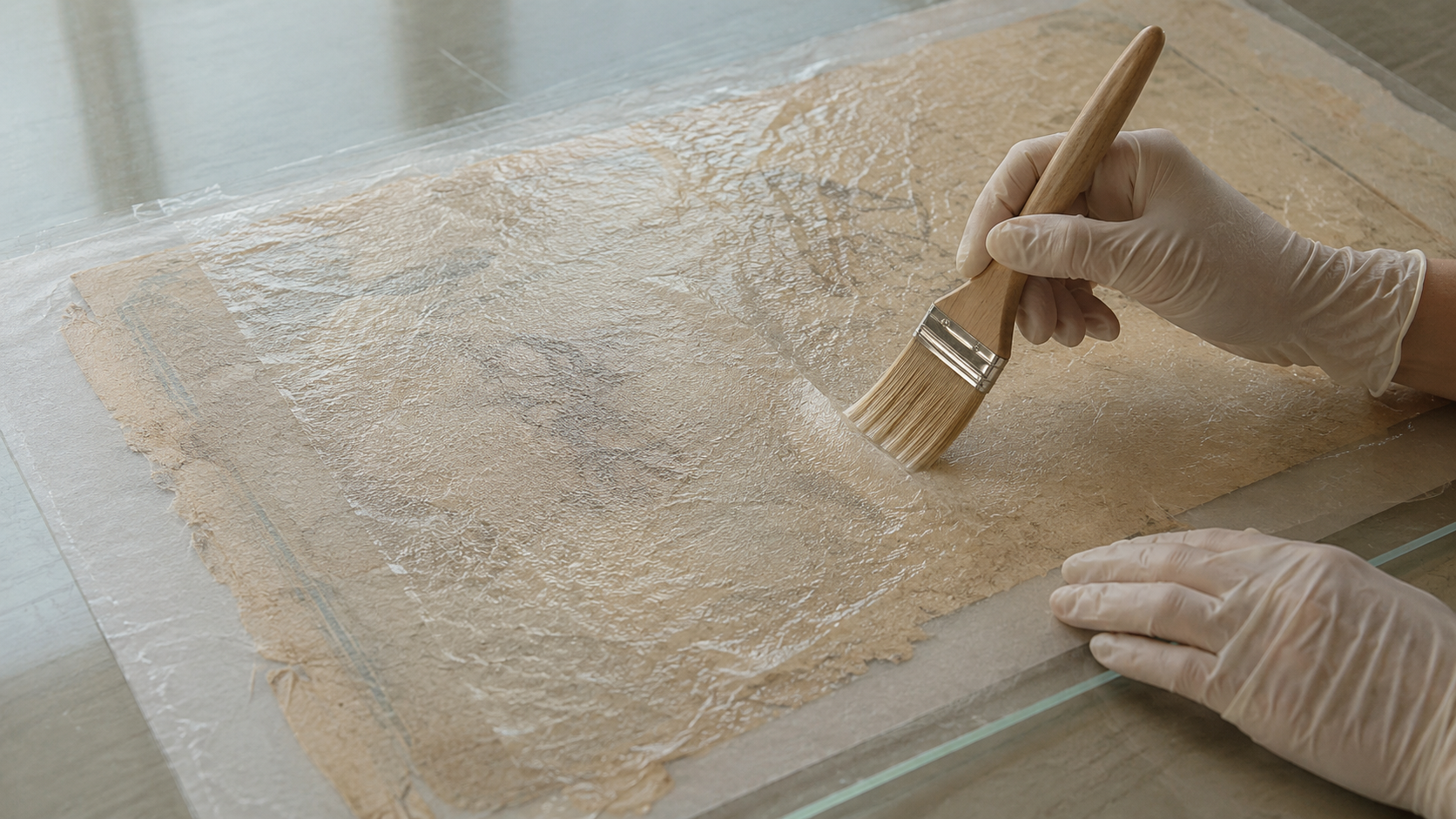
In libraries, washi is used primarily for the conservation of old prints and manuscripts. Pages weakened by time, moisture or improper storage conditions require strengthening before further use or digitalisation. Applying a suitably chosen washi sheet to the verso reinforces the structure of the page while preserving its appearance from the recto. Thanks to very thin varieties, such as tengujo, the repair can be practically invisible once dry.
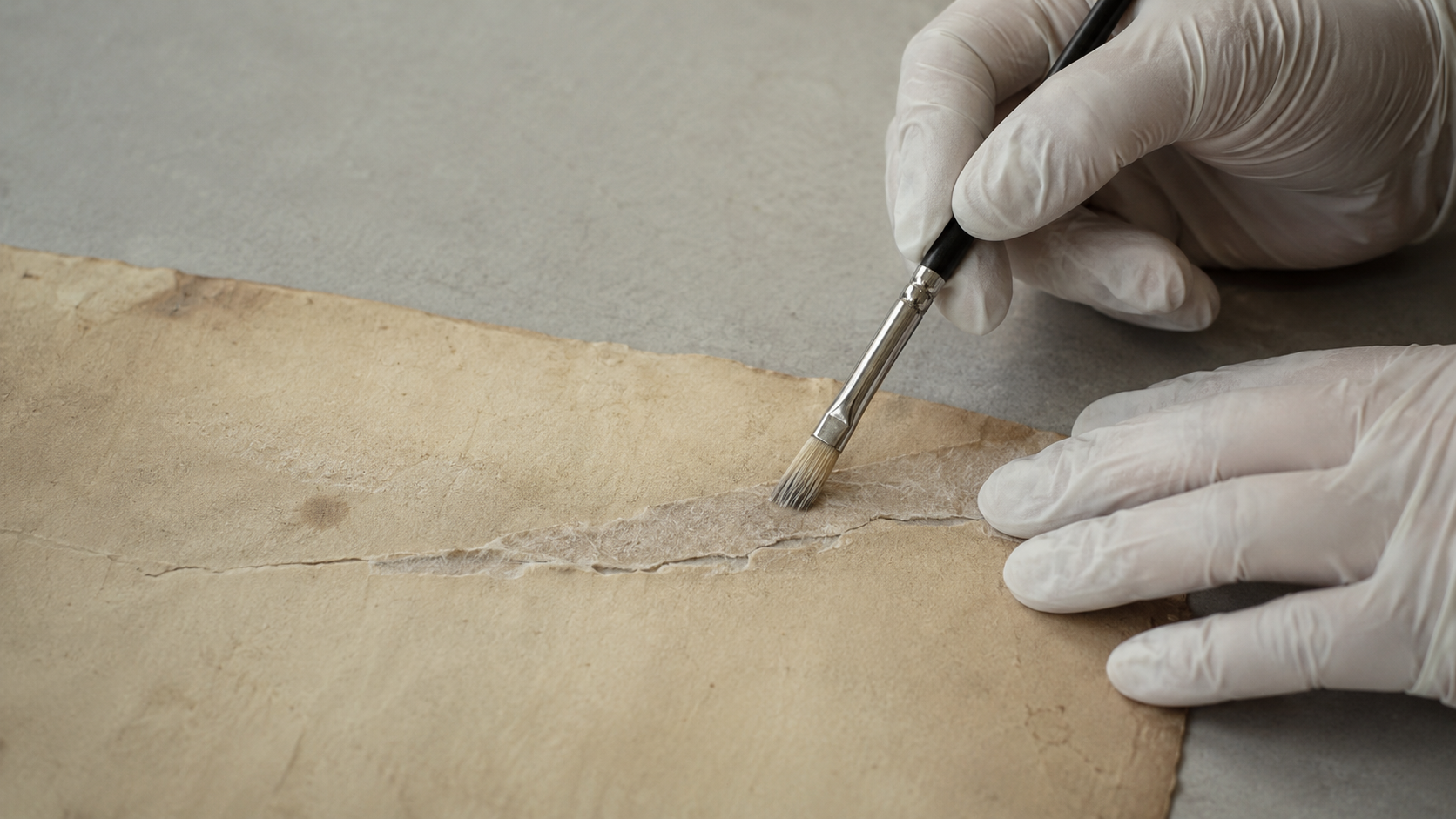
State archives use washi to stabilise official documents, maps and plans. These documents often have irregular shapes, numerous folds and losses. Washi makes it possible to fill in missing fragments in a way that is both visually neutral and mechanically stable. Archive conservators appreciate the ability to dye washi with watercolours or tea to match its shade to the original.
Museums use washi in the conservation of prints, drawings, photographs and works of art on paper. In the case of Japanese and Chinese prints, washi is a particularly suitable material because it comes from the same manufacturing tradition as the original. Conservators working on Asian collections often have a wide range of washi types at their disposal, selected for specific techniques and eras.
Private and academic conservation studios treat washi as a fundamental material, alongside blotting paper Japanese and conservation textiles. Conservation students learn how to work with washi in the very first years of their studies, because the techniques for using it form the foundation of many more advanced repair methods.
The properties of washi that determine its suitability for conservation can be divided into mechanical, chemical and practical.
None of these attributes is unique to washi in isolation. The uniqueness of this material lies in the fact that it combines them all in a single sheet, while maintaining batch-to-batch quality consistency. The latter is essential for institutions that order washi regularly and need the assurance that the next delivery will have the same properties as the previous one.
Choosing the appropriate washi paper for conservation requires evaluating not only the basis weight or colour, but also the manufacturing technology, the type of fibres used and the way they are processed. In conservation practice, the name „washi” itself is no longer a sufficient guarantee of quality, as nowadays it encompasses both hand-moulded and machine-made papers.
Today the market offers hundreds of varieties differing in raw material, weight, texture, production method and fibre origin. A significant portion of modern washi is made from imported kozo originating from Thailand, the Philippines or China, among other places, which differs in properties from traditional fibres cultivated in Japan.
Inappropriate selection can lead to results that are the exact opposite of those intended: a sheet that is too thick will alter the appearance of the object, one that is too thin will not provide sufficient reinforcement, and paper with an inappropriate pH can accelerate the degradation of the original.
When choosing washi tape for restoration, it is worth paying attention to the following parameters:
Renowned suppliers of conservation materials provide sample books containing information on grammage, fibre type, production method and pH value. This allows paper suitable for a specific heritage object to be selected even before purchasing a larger batch. For institutions ordering regularly, it is worth establishing a fixed grade and batch number with the supplier to ensure material consistency in subsequent projects.
Washi available on the European market comes from both traditional Japanese paper mills and modern manufacturers producing paper by hand or machine. When purchasing, it is worth paying attention not only to the trade name, but also to the technical specification including the type of fibres, basis weight, pH value and production method. In the case of the most valuable objects, conservators most often choose hand-made kozo papers, prepared in accordance with traditional technology.
Washi paper is a traditional Japanese paper produced for over 1,300 years. It is made mainly from kozo, mitsumata or gampi fibres and is prized for its durability and strength.
Because it is thin, durable, flexible, works well with conservation adhesives and allows reversible repairs to be carried out.
The most important difference concerns the raw material. Washi is made from long plant fibres, which provide it with high tear resistance and durability.
It began to be used on a wide scale after the flood in Florence in 1966, when its properties proved effective in saving historic collections.
It is used, among other things, for strengthening book leaves and documents, filling in losses, repairing tears, and conserving prints and works on paper.
It is distinguished by high durability with a low basis weight, flexibility, longevity, neutral or slightly alkaline pH, and the possibility of carrying out reversible repairs.
Check our products.