Paper degrades slowly and irreversibly. The acidity of the substrate, moisture, light and inappropriate packaging mean that even a well-stored book loses its structure within a few decades. Archival conservation materials halt this process – provided they have been selected in accordance with the properties of the protected item and the requirements of standards.
Archival conservation materials are products designed not to enter into chemical reactions with the protected objects for decades, and often hundreds of years. They differ from standard office packaging primarily in their chemical composition: they are acid-free, made from materials that meet archival requirements (including the appropriate Kappa number), and free from plasticising substances.
The significance of this distinction is practical. Ordinary PVC film releases hydrochloric acid, which accelerates cellulose degradation. High-acidity cardboard transfers acids on contact to adjacent cards. Adhesives used in cheap office sleeves yellow and stick to the document's surface. Each of these processes is irreversible – no conservator will restore paper to its state before acid damage.
Professional archival materials eliminate these risks through the selection of raw materials. Acid-free archival materials compliant with ISO standards should have a pH within the range of 7.5–10.0. The presence of an alkaline reserve does not imply a separate pH range, but rather a buffering additive (usually at least 2% of calcium carbonate) which neutralises acids formed during the ageing of materials or which permeate from the environment.
The alkaline reserve acts as a buffer: it neutralises acids that can penetrate from the outside or form inside the object as a result of paper ageing. For library and archival collections, this is not an option, but a standard.
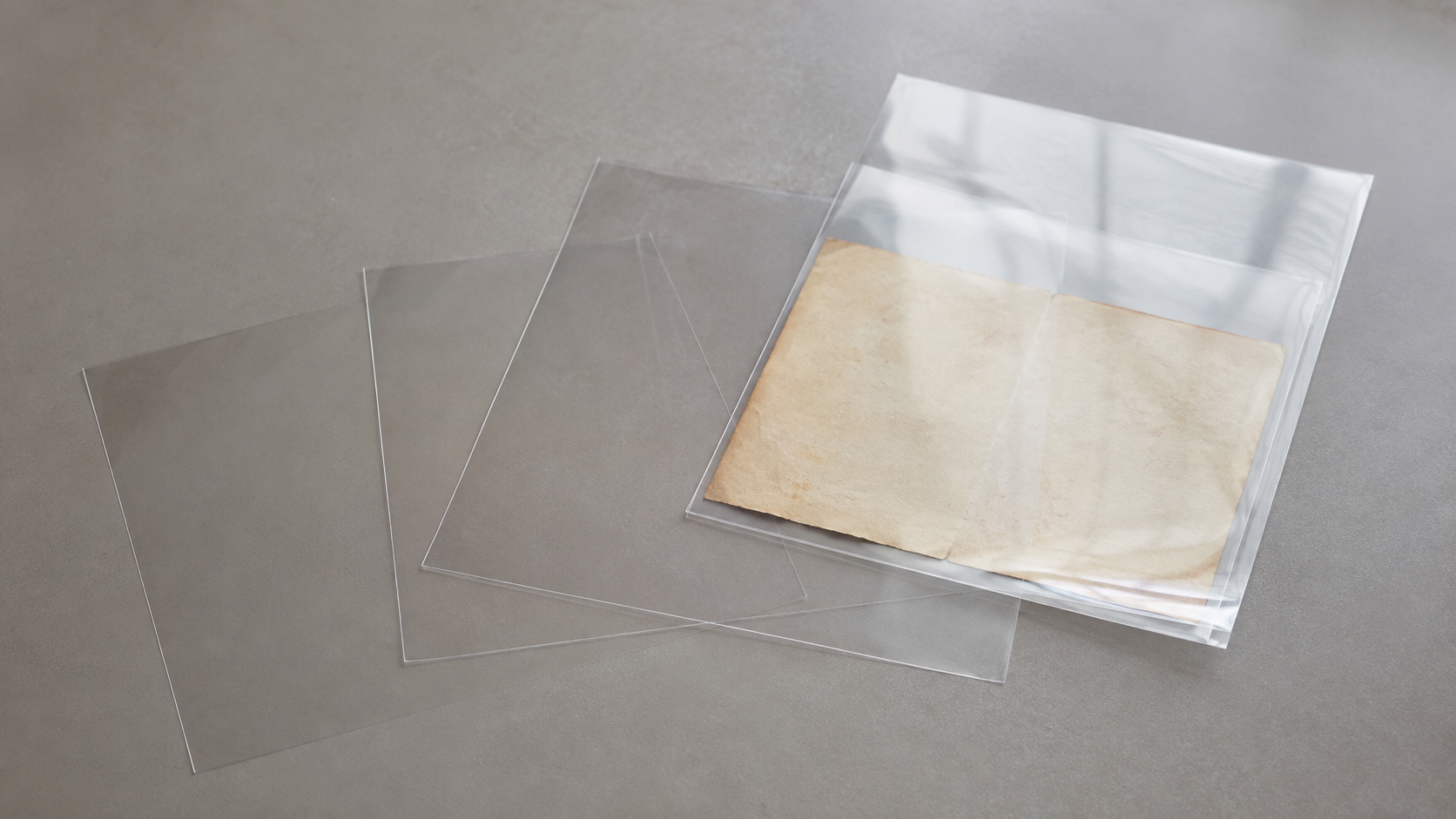
Archival film and archival pocket are two different products that are often confused. Archival film is a material in rolls or sheets, used for wrapping objects, laminating covers or creating protective barriers between layers. An archival pocket is a ready-made product – usually a pocket made of film or polyester, designed for storing single documents, photographs or cards.
The basic plastics used in the production of archival foils and pockets are:
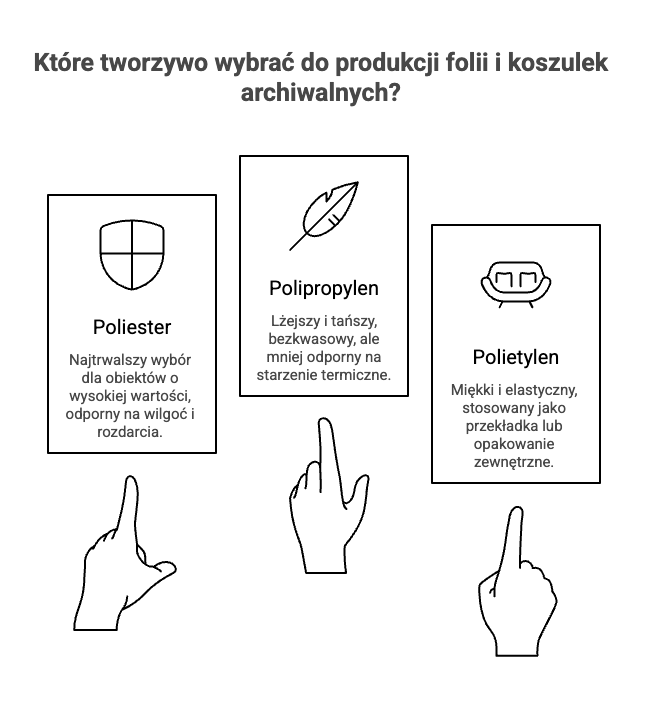
The selection depends on the nature of the collection. Black-and-white and colour photographs require polyester or polypropylene pockets, because PVC and other chlorinated plastics release substances that accelerate the fading of the emulsion.
Parchment documents and maps require sleeves of an appropriate size and film thickness that does not distort the object under its own weight. For books, archival film works well as a protective cover applied over the dust jacket or directly onto the binding.
An archival sleeve intended for photographs should be plasticiser-free and have a positive PAT result in accordance with ISO 18916, which assesses the actual impact of the material on the photographic emulsion during accelerated ageing.
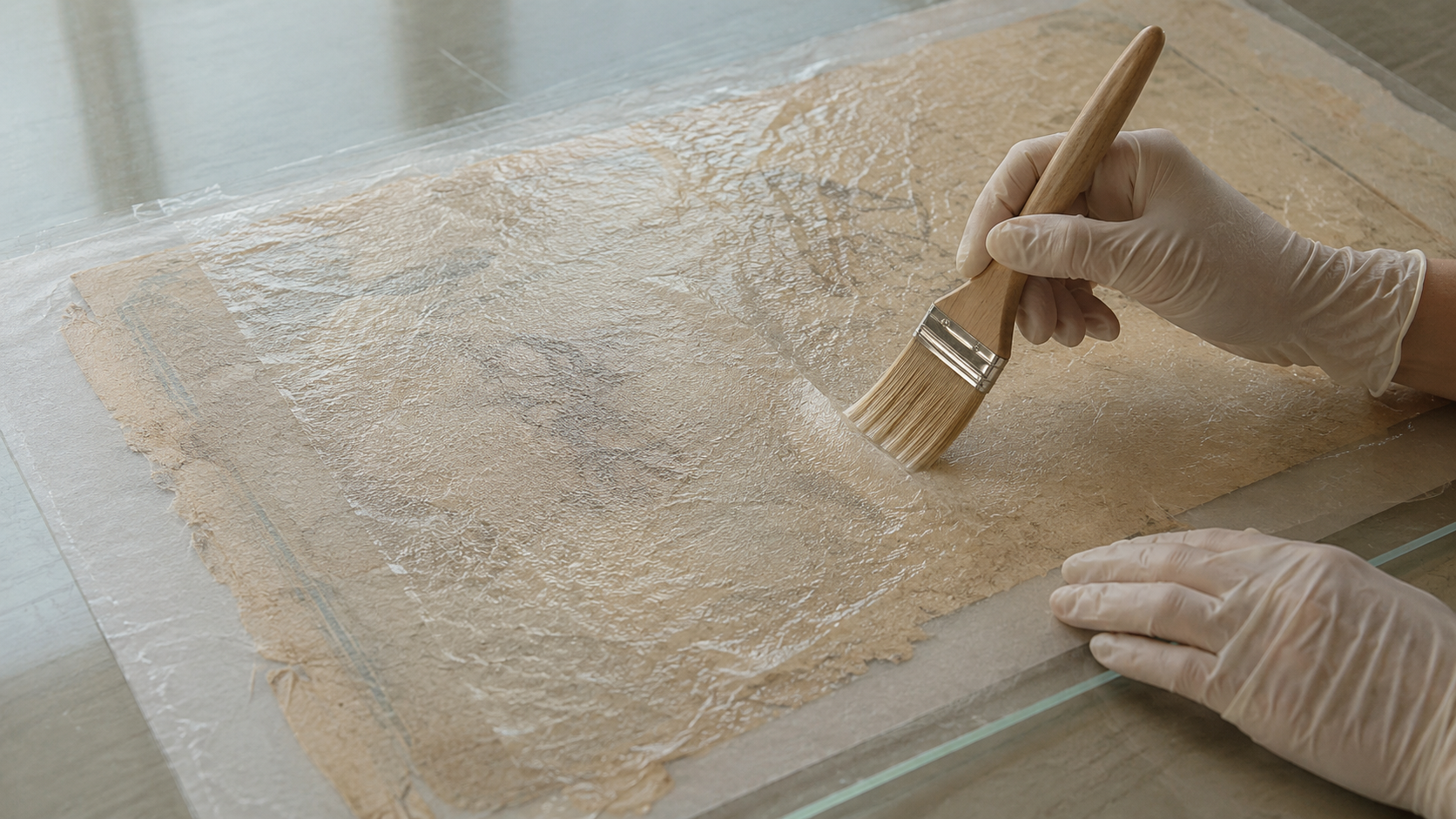
Glassine paper is a paper with a very smooth, dense surface obtained through intensive beating of fibres and calendering. Over the long term, however, it is more prone to becoming brittle than polyester and therefore its periodic replacement is recommended. It is used as an interleaving sheet between pages, a wrapper for delicate graphic objects, and a separating layer in folders and boxes.
acid-free paper it covers a wide range of materials; however, a distinction must be made between permanent paper in accordance with ISO 9706 and archival paper in accordance with ISO 11108, which additionally imposes significantly higher requirements regarding mechanical strength and fibre quality. When choosing acid-free paper for book archiving, it is worth paying attention to:
Acid-free labels are an element of the archiving system that is sometimes overlooked. Standard self-adhesive labels contain acrylic or rubber adhesives which turn yellow and harden over time, and can damage the surface of the binding or document.
Acid-free labels use pH-neutral adhesives that do not migrate into the substrate and retain their properties for many years. They are used for labelling folders, boxes and sleeves without the risk of transferring harmful substances to the protected item.
For labelling packaging, it is recommended to use materials that meet the requirements of ISO 11798 regarding the permanence and durability of writing, printing and copying on paper.
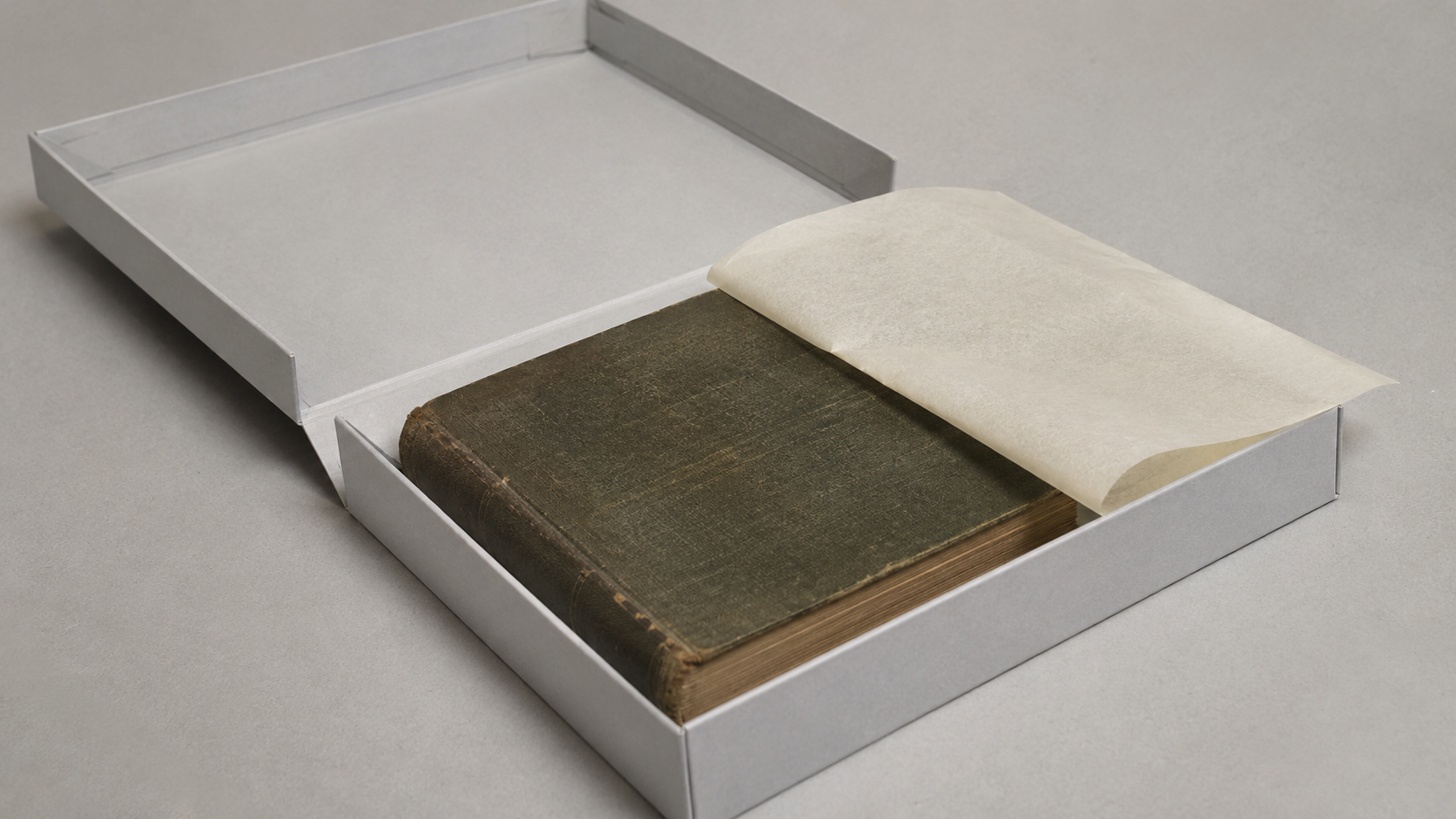
The archival packaging works in layers. A single document goes into poly pockets or is wrapped in parchment paper, then placed in a folder, and the folder in a box. Each layer serves a different function: the sleeve protects against dust and mechanical contact, the folder groups objects and facilitates identification, and the box provides protection against light, humidity fluctuations and physical damage.
Archival boxes complying with ISO 16245 are made from cardboard with a pH of 7.5–10.0 and an alkaline reserve of at least 0.4 mol/kg (approximately 2% CaCO₃).
They are available in several basic formats:
Archival folders made of acid-free cardboard replace ordinary paper folders, which often have a pH below 5 and actively damage stored documents. An archival folder should have rounded corners, a spine adapted to the thickness of the contents, and labelling made with an acid-free label or archival pen. Rounded corners reduce the risk of mechanical damage when removing and inserting documents.
For the most valuable volumes, Solander boxes or clamshell boxes are used. The construction of a Solander box allows the book to be slid out horizontally, reducing the stress acting on the spine and the book block. Such a box is tailored to the specific volume, eliminating any play that causes the item to shift and results in mechanical damage to the spine.
ISO standards provide a benchmark for assessing the quality of archival materials. Manufacturers and suppliers cite them in product specifications, and public institutions require compliance when making purchases. Knowledge of basic standards makes it possible to verify manufacturers' declarations and avoid buying products that fail to meet archival standards.
The most important standards in this area are:
National Archives guidelines state that all archival materials must be placed in protective packaging of archival quality that meets current standards. When purchasing packaging for public institutions, documentation confirming compliance with ISO standards or equivalent national standards should be requested from the supplier.
The needs of a public library, a state archive and a private collector differ in scale, but not in principle. In all cases, the objective is to slow down degradation and ensure access to the item without the risk of damaging it.
In libraries, archival materials are primarily used for the protection of special collections: early printed books, manuscripts, maps, prints and photographs. Standard procedures include placing items in polyester or polypropylene sleeves, interleaving with archival foil or parchment paper and storage in acid-free boxes. Vertical or horizontal arrangement depends on the format and condition – books with weakened spines are stored horizontally to avoid mechanical stress.
State archives apply similar principles, with an emphasis on the standardisation of packaging formats and a uniform description system. Folders and boxes must have acid-free labels with the identification data of the archival unit, and the description itself should be made using permanent pigment ink or laser printing on acid-free paper.
Private collectors often start with a basic set: polypropylene sleeves for documents and photographs, glassine paper as interleaving tissue, and acid-free boxes for the most valuable items. When expanding the collection, it is worth introducing a cataloguing system with acid-free labels and an inventory that makes it possible to locate a specific item without opening all the boxes.
Storage conditions should comply with the recommendations of PN-ISO 11799. For most paper collections, a temperature of 16–18°C and a stable relative humidity of approximately 40–50% are recommended, with as little daily fluctuation as possible.
Errors made during archiving usually stem from a lack of information about material properties or from trying to economise during the purchasing stage. The consequences are delayed over time – damage only becomes apparent years later, when repair is either impossible or very costly.
The most common mistakes are:
Every one of these errors can be eliminated by choosing certified archival materials and adhering to basic storage principles. Investing in appropriate packaging is a one-off cost that protects items for decades. The cost of restoring or conserving a damaged document vastly exceeds the price of proper packaging.
The selection of archival materials for conservation requires taking into account the type of item, storage conditions, and ISO standard requirements. Archival film and sleeves protect against dust and mechanical contact, archival glassine paper separates layers and limits moisture penetration, and acid-free labels ensure permanent labelling without the risk of chemical damage. Acid-free cardboard boxes and folders complete the system, creating a stable storage environment.
These are acid-free materials, designed not to react chemically with the protected objects and to provide them with long-term protection.
Because they may contain acids, plasticisers or adhesives that accelerate the degradation of paper, photographs and other materials.
Archival film is a roll or sheet material used for wrapping and protecting objects, whereas an archival pocket is a ready-made sleeve for storing individual documents or photographs.
It is used as an interleaving sheet, wrapper or separating layer for delicate archival materials.
They enable permanent labelling of folders, boxes and sleeves without the risk of damaging the stored items.