
Repairing a damaged spine, reinforcing weakened folds, or constructing a durable archival box are tasks requiring a special-purpose adhesive. A book's spine functions like a complex hinge. – must withstand powerful mechanical stresses during each opening, while simultaneously forming a stable barrier protecting the interior of the block. For centuries, animal (bone) glues and vegetable (starch paste) glues reigned supreme in bookbinding workshops. Today, however, PVA glue is the foundation of most studios.
Why have polyvinyl dispersions almost entirely replaced traditional solutions in everyday work? When is the application of this synthetic polymer a technological savour, and in what situations does it constitute a conservation blunder? Discover the parameters, properties, and modification principles of the adhesive that revolutionised bookbinding.
PVA, or polyvinyl acetate, is a synthetic polymer that in bookbinding appears as a thick, aqueous dispersion enriched with plasticisers. In its liquid form, it has a characteristic white colour; however, once completely dry, it becomes a fully colourless, flexible, and waterproof coating.
The secret to the effectiveness of professional PVA lies in its physicochemical properties. The most important of these is the high dry matter content. In professional products, it ranges from 52% to as high as 58%. This means that the aqueous carrier constitutes less than half of the volume in the preparation. This reduces the phenomenon of paper rippling and creasing due to moisture to an absolute minimum. Traditional, rare beaters introduce a huge amount of water into cellulose fibres, which greatly hinders working with delicate materials without the use of heavy presses.
Another advantage of PVA is its property of becoming less viscous under brush strokes and then immediately returning to its original thickness once the strokes cease. This ensures an extremely precise application. – the glue does not run off the edge of the spine and does not stain the margins. To achieve such desirable properties in your workshop, it's worth reaching for tried and tested Specialist adhesives Developed for book binding and archiving.
Many beginner restorers are misled by appearances. Since popular white office, school, or woodworking glues are also based on polyvinyl acetate, can they be used to glue a book? The answer is: under no circumstances.
Cheap commercial dispersions are formulated for a completely different purpose. They dry to form an extremely hard, rigid, and crystalline structure. Using such a binder on a movable part of a fixture will lead to disaster. During the continuous operation of the spine – when opening and closing the leaves, the hard as glass joint of wood glue will simply crack, drastly tearing the already weakened paper fibres. Professional PVA maintains extreme flexibility and withstands temperature amplitudes of -30°C to +60°C upon full curing, guaranteeing the book will function without damage for many years.
Although traditional wheat starch paste is invaluable, it has one critical drawback: it is entirely natural. Gluten proteins provide an ideal breeding ground for micro-organisms. So where does PVA work best?
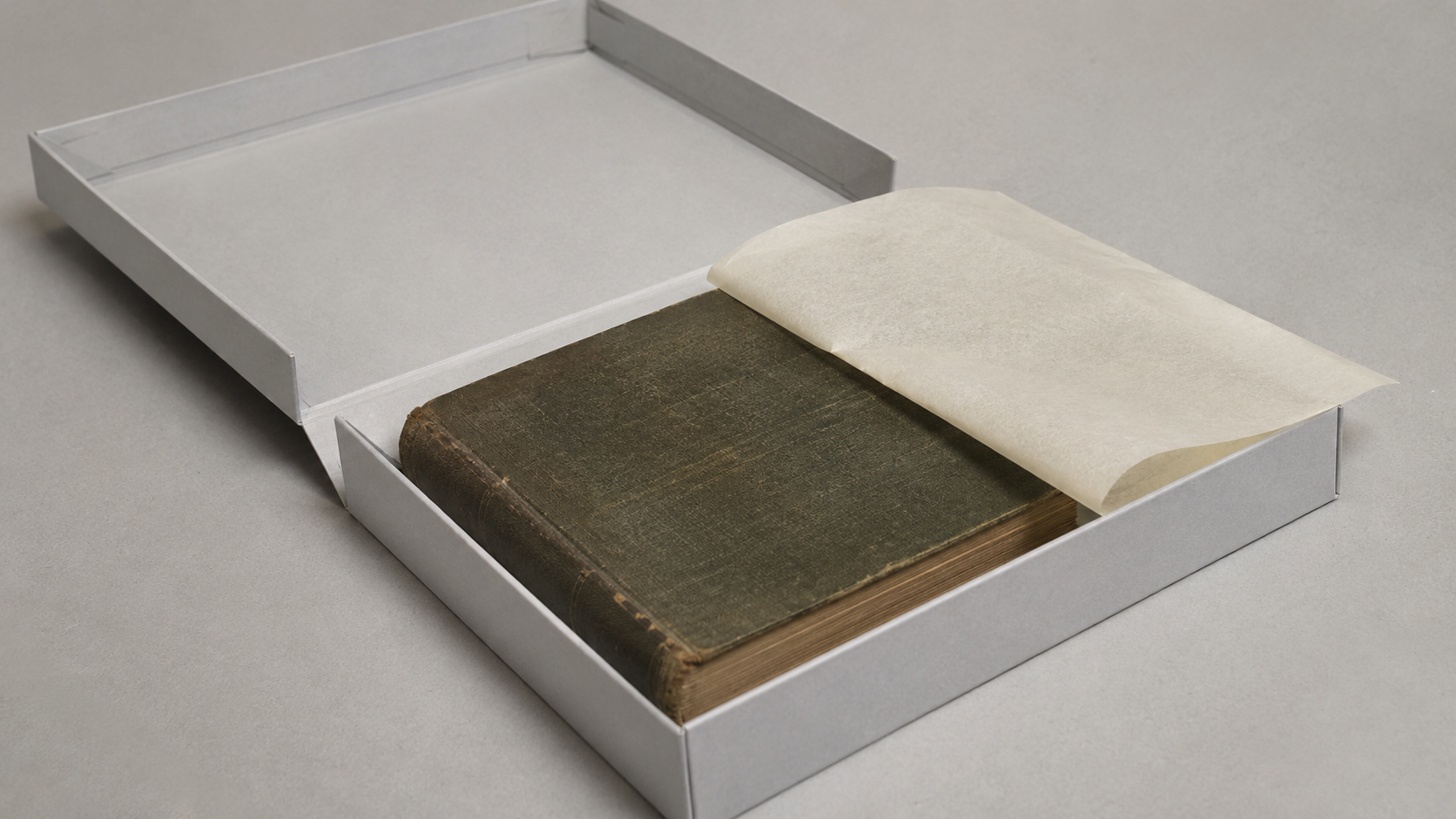
All materials necessary for the construction of solid protective structures, including acid-free cardboard and canvas, form the basis of the department Repair and renovation In our shop for conservators.
The application of PVA involves a significant compromise, which forms the axis of dispute between artisans and museum conservators. This concerns the crucial issue of reversibility of treatments in this industry.
The golden rule of monument conservation states that any intervention in a historic object must be reversible in the future without damaging the original. While starch paste is easily removed with moisture, coatings of pure polyvinyl acetate are essentially insoluble. The removal of old, fossilised PVA from a porous substrate is a highly risky process. Modern bookbinders deal with this problem by applying thick starch poultices to the old covering, which very slowly softens the polymer and allows it to be carefully scraped off with a scalpel.
The second challenge is the emission of volatile organic compounds. Research carried out by the US Library of Congress has shown that polyvinyl glues can emit microscopic vapours for up to 6 years after application. While this is not harmful to the paper itself, these gases are destructive to historical copper alloy elements (e.g. antique clasps and fittings on covers). For this reason, in the case of the most valuable incunabula and early printed books with metal embellishments, synthetic polymers must absolutely give way to natural adhesives.
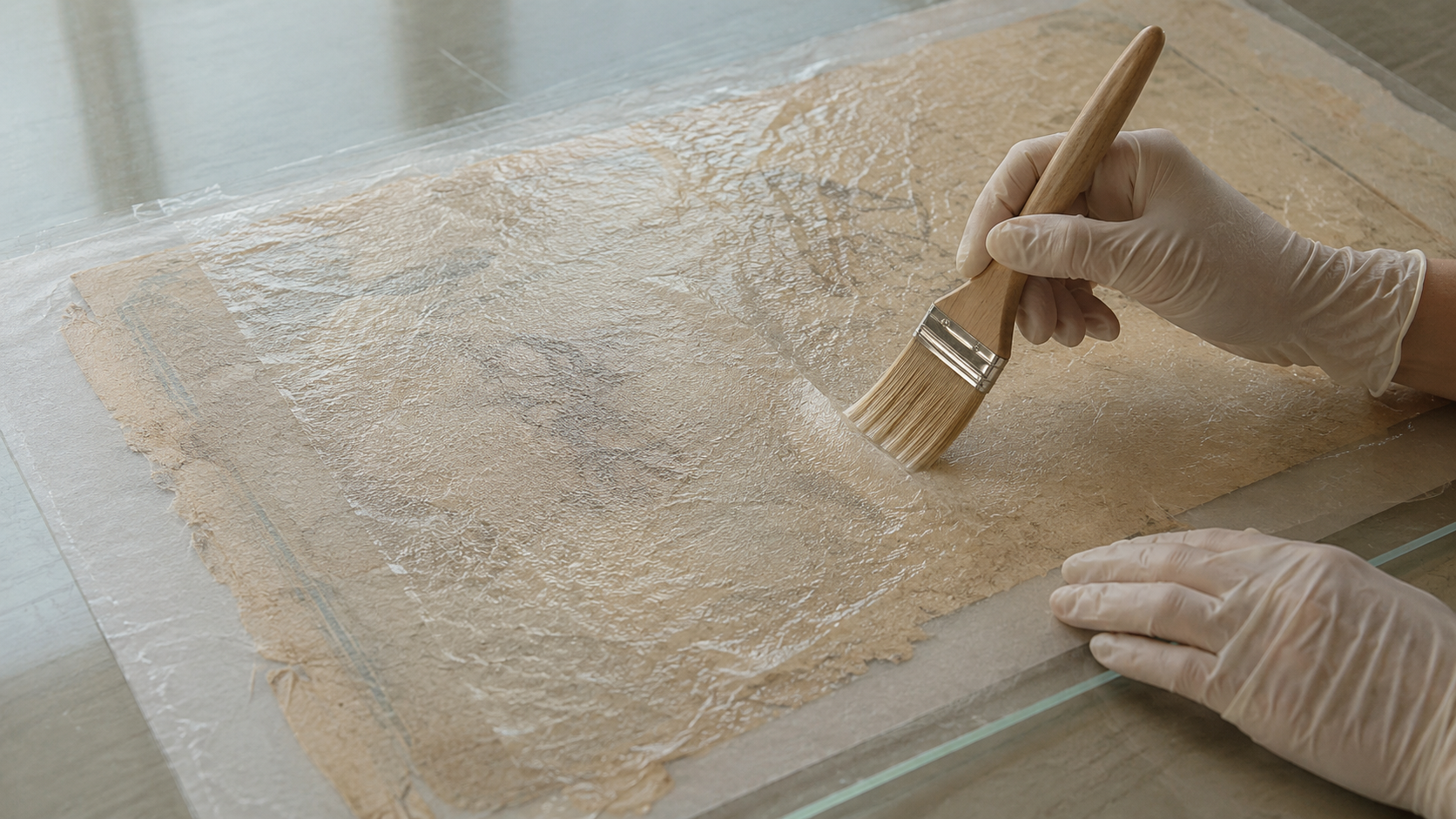
Standard PVA has a very short „open time” – usually once applied, we only have about 2 minutes to make corrections. When working with large formats (e.g., covering entire book covers), the adhesive can dry before you manage to lay the sheet down evenly. Furthermore, on very brittle, historic Japanese papers, the thick resin offers such considerable resistance that an unfortunate brushstroke can tear the weakened sheet.
The solution is to create a hybrid by adding methylcellulose (MC). Methylcellulose gel acts as an excellent slip agent and a safe drying retardant.
Preparation procedure for hybrid (PVA + MC):
To make it easier to choose the right substance for a specific project, we have prepared a simplified table of properties for the most popular binders.
| Type of Binder / Glue | Chemical Base | Main Advantage | Main disadvantage | Recommended use |
| PVA bookbinding adhesive | Vinyl polyoctane with plasticisers | Fast setting, high flexibility, resistance to mould | Lack of reversibility in water, long-term emission of vapours | Structural repairs, heavy-duty protective cases, utility fixtures |
| White wood glue | Rigid polyvinyl acetate | Low price, high holding force for solid timber | It creates a brittle weld, cracks under the stress of the ridge's movement | Creating rigid and immobile structures from thick cardboard |
| Wheat starch paste | Water + gluten proteins | Full reversibility, joint softness, historical neutrality | Susceptibility to mould and insect attack, slow drying | Rigorous conservation of priceless artefacts and old prints |
| Methylcellulose (MC gel) | Plant cellulose | Biological resistance, slip properties | When used alone, it has minimal binding strength | Diluent and drying retarder for polymer adhesives |
Simply having a good adhesive is only half the battle. Proper application requires the right tools. Evenly spreading viscous dispersions needs stiff, broad hog-bristle brushes that can handle the physical resistance of the polymer. Smoothing glued surfaces is made easier by professional Bookbinding board, which prevent damage to the paper surface during strong pressing. All these elements, constituting the basic Workshop equipment, which can be easily assembled by reaching for the specialised range from CartaPro's offer.
Pay attention also to the chemical environment of the work. Aim to use acid-free polymers (with a neutral pH), as standard industrial vinyl adhesives can have a pH of around 3.0, which over the years will negatively affect the behaviour of the paper immediately at the join.
PVA glue is not a universal, magical solution for absolutely all bookbinding and conservation problems, but it is a fundamental tool in the hands of a knowledgeable artisan. Where mechanical strength of the binding, resistance to moisture, protection against mould, and speed in constructing solid three-dimensional structures are crucial, flexible polyvinyl dispersions remain unrivalled.