The endpaper is a structural element of a book that connects the block to the hard cover. For years, it remains unseen. Until it starts to delaminate, crack, or detach from the cover. It then turns out that this seemingly simple sheet of paper, folded in half, performs a structural function, without which the binding loses its coherence. Learn more about endpaper, its types and selection criteria. Also, learn about the replacement technique.
The choice of endpaper material depends on the function it needs to fulfil and the character of the book being bound.
Offset paper is the material most commonly used in practical bookbinding. It is characterized by good mechanical strength, a uniform structure, and predictable behaviour during gluing. Handmade or semi-handmade paper, known as mould-made paper, is used for artistic bindings and the conservation of historical books. It has an irregular fibre structure, which gives it resistance to tearing. However, it requires a more careful choice of adhesive due to its variable surface absorbency.
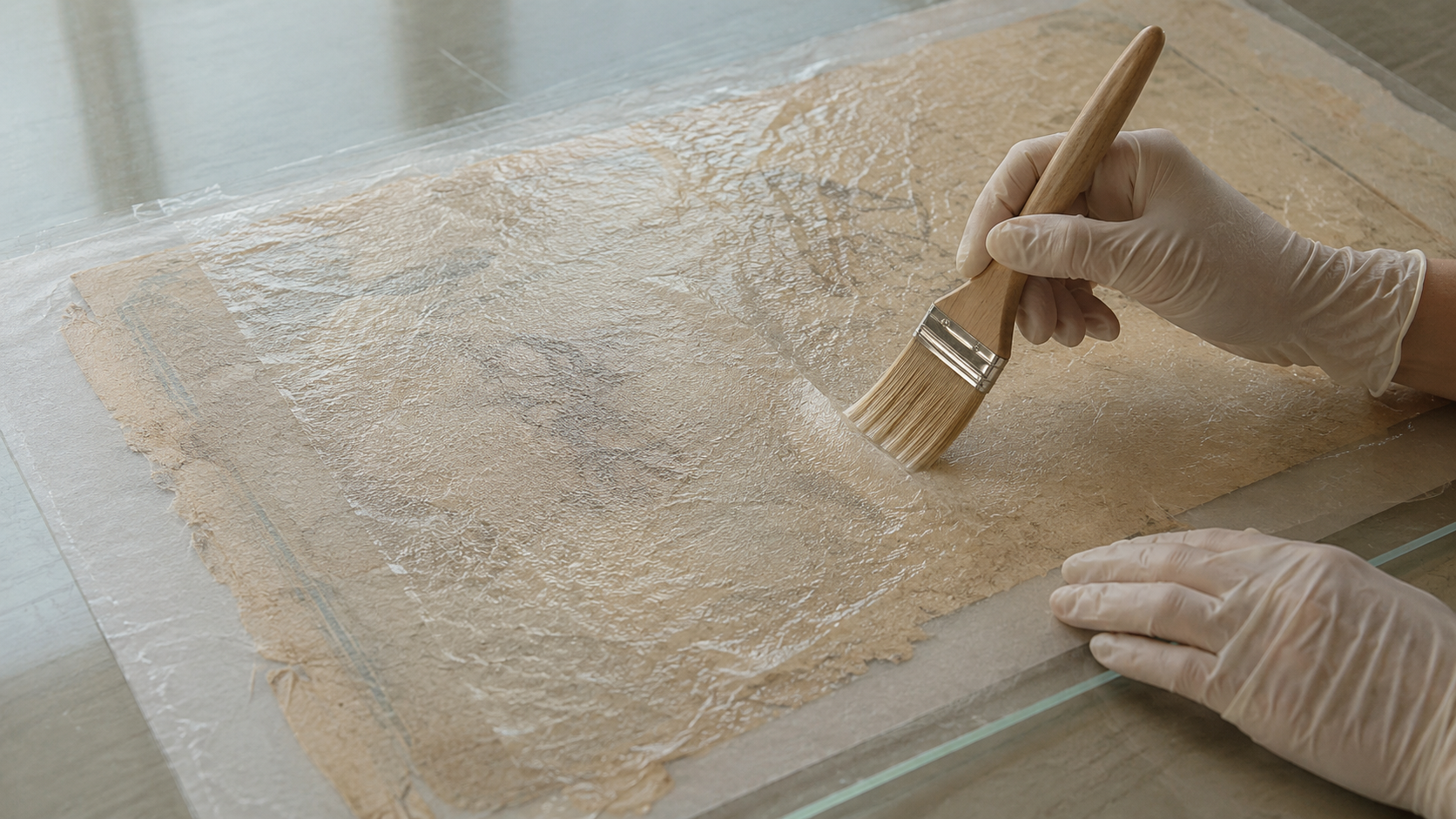
Japanese paper, made from plant fibres such as kozo, mitsumata, or gampi, is characterised by its exceptional strength at a very low basis weight. The basis weight range is from a few to several tens of grams per square metre. In conservation, it is used for reinforcing weakened endpapers, backing tears, and as an intermediate layer in repairs. The long, entangled fibres create a tear-resistant structure even at a thickness comparable to tissue paper.
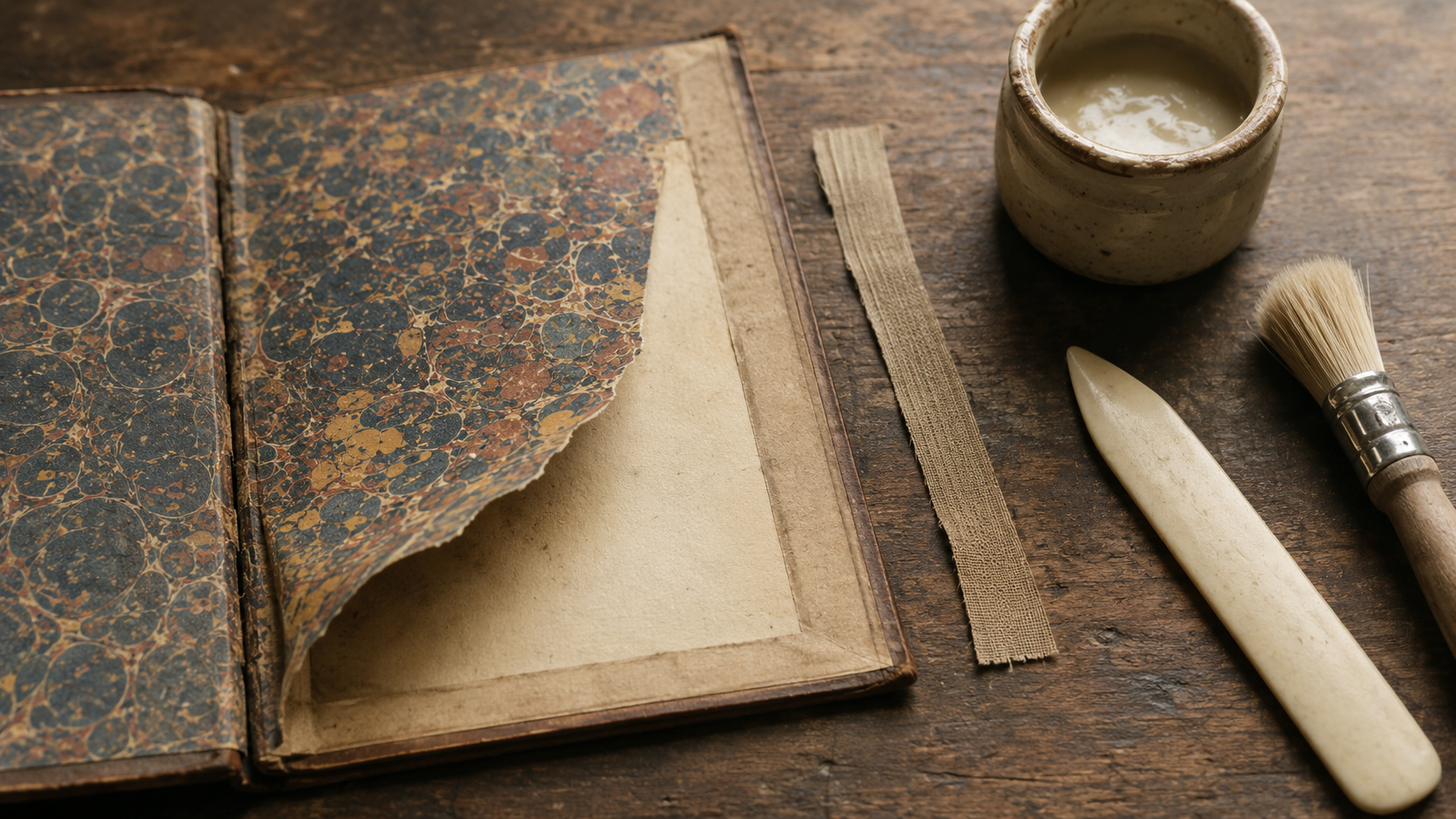
Marbled paper, also known as Florentine paper or Ebru, is a traditional decorative material used in bookbinding since the 16th century. The patterns are created by applying paints to the surface of a thickened solution, and then transferring them onto paper. The weight of the base paper is typically between 80 and 120 g/m². When selecting marbled paper for endpapers, check that the substrate is sufficiently robust and that the paints are resistant to the action of glue.
Lining canvas – cotton or linen, impregnated or unimpregnated – is used as a reinforcement for endpapers in areas subjected to stress, i.e., near the spine. A narrow strip of canvas glued along the fold of the endpaper significantly increases its resistance to repeated opening of the cover. In library and archival bindings, such reinforcement is standard.
The distinction between decorative and acid-free endpapers primarily concerns the intended use of the book and the durability requirements of the materials.
Decorative endpapers enhance the aesthetic appeal of a binding. Dyed, marbled, printed, or textured papers are used here. These materials do not need to meet archival requirements, although decorative papers combining aesthetic qualities with a neutral pH are increasingly available.
Acid-free backing is a requirement for the preservation of antique books, archival documents, and all objects intended for long-term storage. Acid-free paper has a pH above 7 and often contains an alkaline reserve in the form of calcium or magnesium carbonate, which neutralises acids migrating from the surroundings.
Marmoration of the edges of a book block is a decorative process that often accompanies marbled endpapers. The edges of the block are dyed or marbled to create a cohesive whole with the endpaper pattern. This technique requires proper preparation of the block and the use of paints or dyes compatible with the paper.
When selecting paper for a conservator's lining, material certificates confirming compliance with ISO 9706 or ANSI/NISO Z39.48 standards should be checked.
The choice of paper for the endpaper should take into account three variables:
For contemporary books intended for everyday use, offset paper with a grammage and fibres running parallel to the spine is sufficient. Colour and texture are a matter of aesthetics.
For books from the 19th and early 20th centuries, bound in leather or cloth, the correct choice is handmade paper or paper with a texture similar to the original. If the original endpaper was marbled, the new one should echo the pattern and colour palette of the era. It doesn’t have to be identical though, but it should be stylistically consistent.
For archival and museum objects, the rule is: only acid-free materials with confirmed durability parameters. Paper weight should match the original or be slightly higher if the original is fragile. Japanese paper is used for reinforcement, not as a standalone endpaper material, unless dealing with very delicate objects requiring minimal intervention.
Preparing a book for spine reinforcement begins with an assessment of the condition of the entire object. Before starting the work, the initial condition must be documented – photographically and descriptively. The documentation covers the state:
The next step is to remove the old endpaper. If the pasted endpaper is peeling off on its own, it can be carefully separated from the cover. If it adheres firmly, humidification with steam or diluted water solutions is used, which soften the adhesive without soaking the paper. Mechanical scraping is only permissible using tools with rounded edges and only when there is no risk of damaging the cover board.
After removing the old endpaper, the cover surface must be cleaned of any remaining adhesive. Starch-based adhesive residues can be removed with a damp sponge, while synthetic adhesive residues should be removed with a suitable solvent, chosen according to the type of adhesive and cover material. The surface must be dry and even before attaching the new endpaper.
The book block requires checking the condition of the first and last sheets. If they are damaged or acidified, they should be reinforced with Japanese paper before proceeding with gluing the new endpaper.
The first stage is the preparation of the new endpaper. A sheet of paper is cut to size, taking into account the block format and cover thickness. The grain direction must run parallel to the spine. If the endpaper is to be reinforced with mull, a strip of binding mull is glued along the fold before folding the sheet.
The second stage is attaching the endpaper to the block. A narrow strip of glue is applied along the spine of the block, after which the endpaper is attached and pressed through blotting paper or silicone paper. The glue should only adhere to the spine – the rest of the endpaper remains free.
The third stage is sticking the pastedown to the cover. The glue is applied evenly over the entire surface of the pastedown or the inner side of the cover, depending on the technique and type of glue used. The pastedown is placed on the cover, aligned, and pressed through silicone paper or foil. The book is placed under a press or weight to dry.
The fourth stage is the check after drying. The evenness of adhesion, absence of bubbles and creasing, and correct opening of the cover are checked. If the endpaper creases at the spine, the cause is usually too much glue or insufficient drying time under pressure.
The choice of adhesive is one of the decisions with the greatest impact on the durability of a repair. In bookbinding and conservation, several groups of adhesives are used, differing in their properties and applications.
Starch paste, produced from wheat flour or rice starch, is a traditional bookbinding material with a long history of use. It is reversible – it can be removed with water. This is an advantage in the conservation of historical objects. It has a low content of harmful substances and is compatible with paper and fabric. A disadvantage is its sensitivity to moisture and susceptibility to biological attack in the absence of appropriate storage conditions.
Methylcellulose and hydroxypropyl methylcellulose (HPMC) are synthetic materials with properties similar to starch paste. They are reversible, have a neutral pH, and are resistant to biological attack. They are used alone or in a mixture with starch paste for desired viscosity and open time.
Polyvinyl acetate (PVA) adhesive is characterised by high mechanical strength and a short drying time. It is used in bookbinding where the durability of the bond is more important than reversibility. In the conservation of historical objects, PVA is used with caution and only in places where reversibility is not required, or in a mixture with starch paste to improve reversibility.
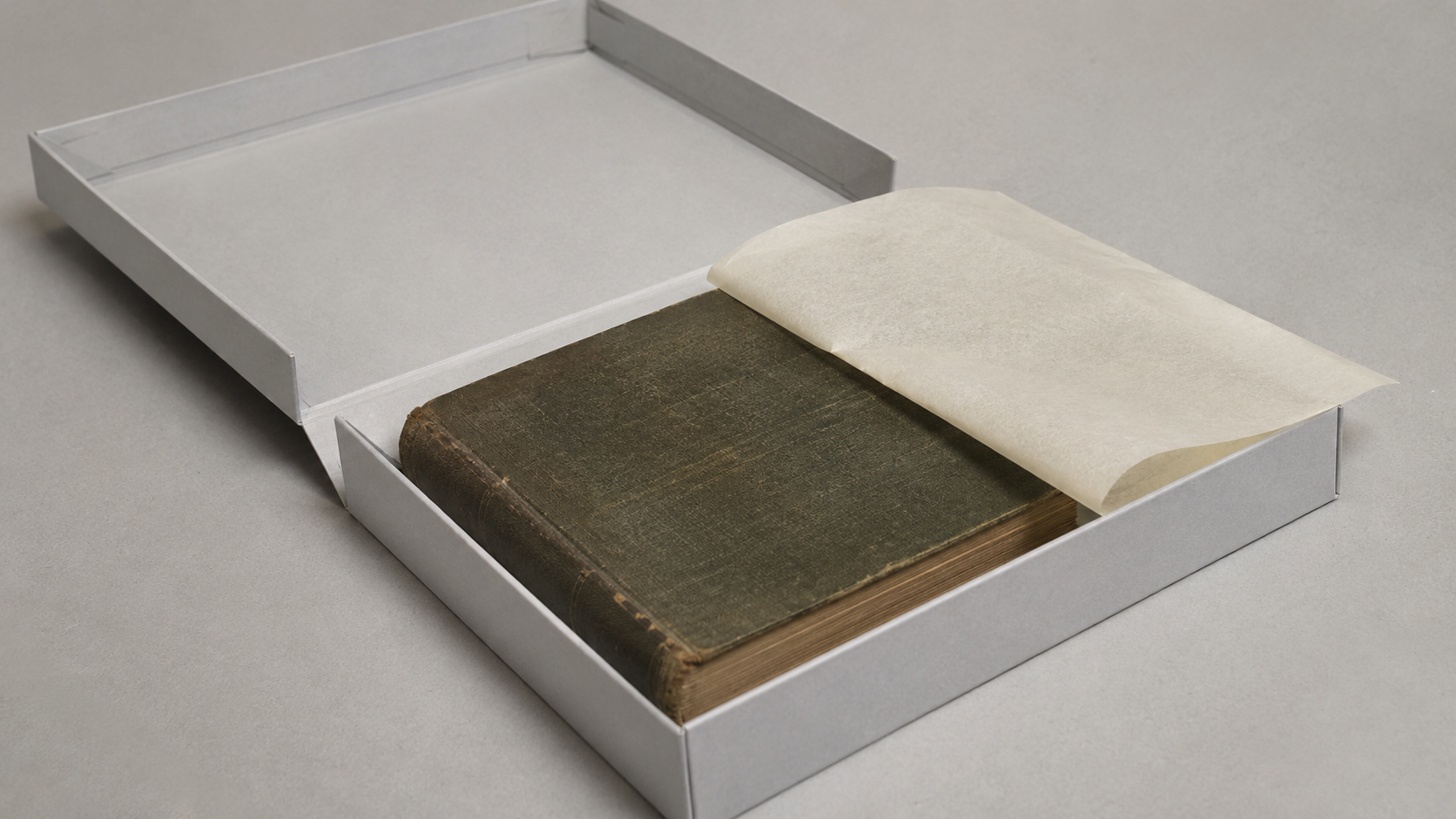
Once the endpaper has been replaced and you have ensured that the adhesive has dried completely, the book should be stored in conditions suitable for its materials. For paper objects, the optimum relative humidity is 45–55%, and the temperature should not exceed 18–20°C. Sudden changes in humidity are more harmful than a constant deviation from the norm.
Books are stored vertically or horizontally after repair, depending on their format and weight. Heavy, large-format volumes are better stored horizontally, as vertical storage puts strain on the spine and the new endpaper. Vertically stored books should have side support to prevent them from tilting.
Regular inspections of the fitting's condition allow for the detection of early signs of renewed damage to the binding strip. Early intervention is always less invasive and less costly than repairing advanced damage.
Replacement is necessary when the lining is coming away from the cover, there are cracks at the spine, the paper is delaminating, or there are unsuitable materials from previous repairs.
The endpaper connects the book block to the cover, transfers stresses during opening, and protects the pages from the influence of the cover materials.
Yes, acid-free paper limits the migration of acids and helps protect historical and archival books from further degradation.
No. If the spine of the book is also damaged, it may need to be repaired, as a new endpaper could be damaged again.