
On the shelves of archives, libraries and in private collections, a silent, self-sustaining process of destruction of our written heritage is taking place. This phenomenon, referred to in specialist literature as „slow fires”, leads to a drastic reduction in the mechanical strength of the pages and their irreversible degradation. Polish diagnostic data indicate that the problem of critical acidification affects as much as 90% of library materials produced on machine-made paper in the 19th and 20th centuries. To halt this process, extensive chemical intervention is required.
Understanding what deacidification of paper is, is fundamental to modern conservation. This treatment allows for extending the lifespan of documents, books, and artworks by tens, or even hundreds, of years. Learn why cellulose degrades so quickly, what the mechanism of acid neutralisation entails, and what standards determine whether a given material can be considered fully safe for historical collections.
The crisis in contemporary archival science has its roots in the Industrial Revolution. Until the turn of the 18th and 19th centuries, paper was made by hand, using cotton and linen fibres obtained from rags. This was a naturally durable and alkaline medium. The situation changed radically with the invention of the paper machine and the shift to mass production based on wood pulp.
However, the real catalyst for the problem turned out to be a new method of sizing paper. Industry began to widely use acid solutions, mainly aluminium sulphate (alum) and rosin. These compounds introduced a highly destructive environment into the carrier's structure. The process of acid hydrolysis began. – reaction in which cellulose chains undergo drastic shortening. Worse still, this process is autocatalytic. This means that the degradation of the structure generates the formation of further acids as by-products, which logarithmically accelerates further decomposition. The effect? Books and documents from this period turn a strong yellow, and their pages become so brittle that they break with the slightest fold.
Deacidification is an advanced chemical treatment based on two key pillars. The first is the complete neutralisation of acidic substances already residing within the cellulose fibre structure. The second, equally important from a preventative perspective, is the deposition of excess alkaline substances into the paper.
This precisely measured reserve is called the alkaline reserve (basic buffer). This reserve acts as a protective shield. Its task is to absorb and neutralise acids that may form in the future as a result of natural ageing of the material, as well as those originating from environmental pollutants (e.g. absorption of sulphur dioxide from the air). Most commonly, magnesium or calcium compounds act as buffering agents.
The struggle to halt the wave of cellulose decay has led to the development of strict regulatory frameworks. These have redefined the concept of durability for conservation and archival materials. The most important international indicator in this regard is the ISO 9706 standard, which defines the parameters for so-called permanent paper.
For an archive medium to be considered compliant with the ISO 9706 standard, it must meet stringent conditions:
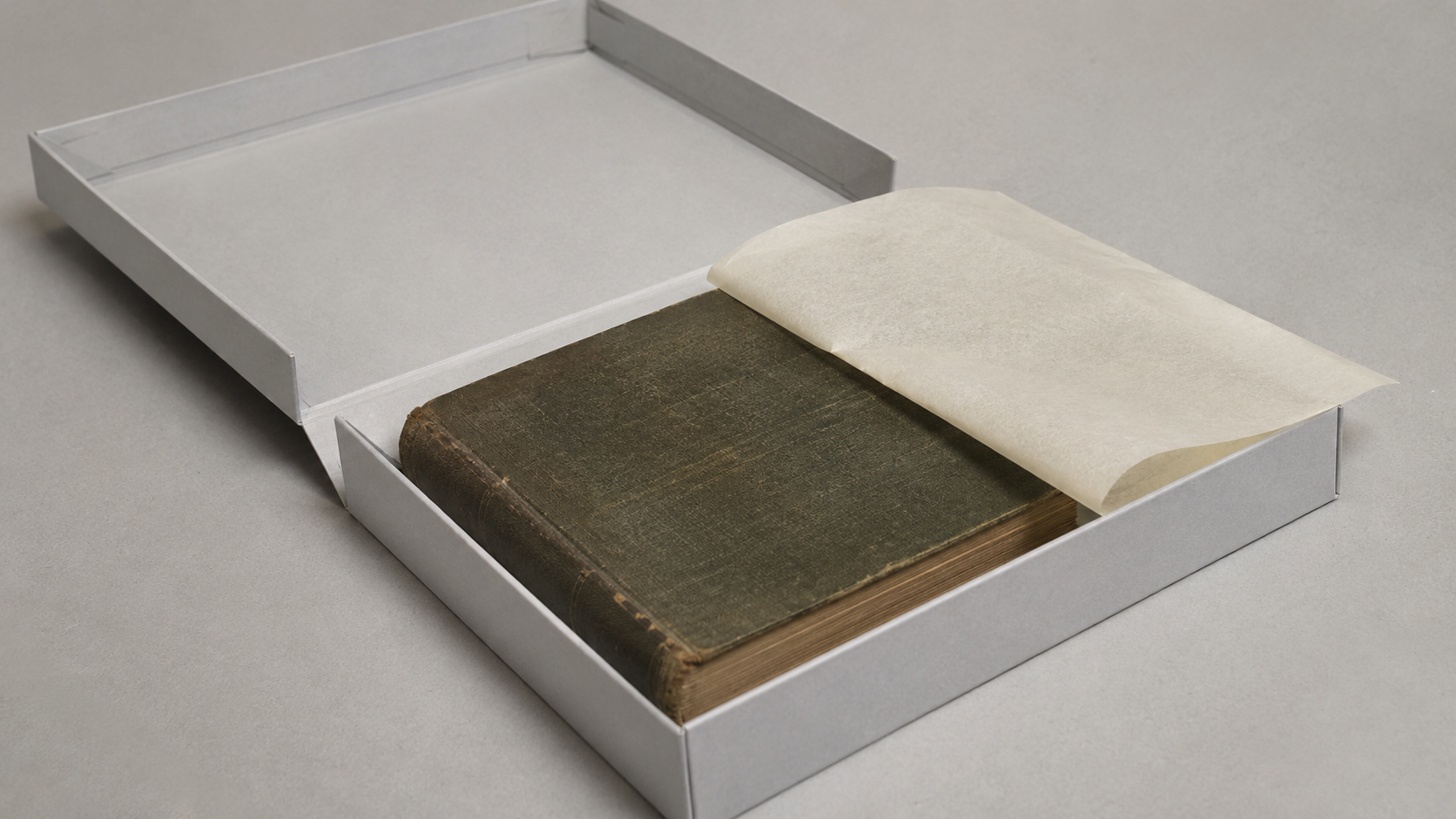
For the most valuable systemic and historical artefacts, an even more restrictive ISO 11108 standard for archival paper is applied. It requires the paper to be produced from fine, long fibres of cotton, linen or hemp. When choosing acid-free paper For repair purposes, including protective cardboard and dividers, strict attention must be paid to compliance with the above standards.
The problem of fragile paper has forced large institutions to implement mass technologies. Deacidification of entire book collections on an industrial scale is now carried out in giant vacuum chambers, using non-aqueous liquid-phase technologies. The elimination of water from the process protects the paper structure from warping and inks from blurring.
In Poland, as part of a major government programme implemented by, among others, the National Library and the Jagiellonian Library, Bookkeeper technology has been employed. It is based on introducing micrometric particles of magnesium oxide (MgO) suspended in an inert perfluoroalkane solvent into the paper structure. In turn, other European technologies (e.g. Papersave) are based on fully homogeneous titanium-magnesium ethoxylate solutions, which penetrate the fibres at a molecular level, yielding even higher mechanical stability coefficients.
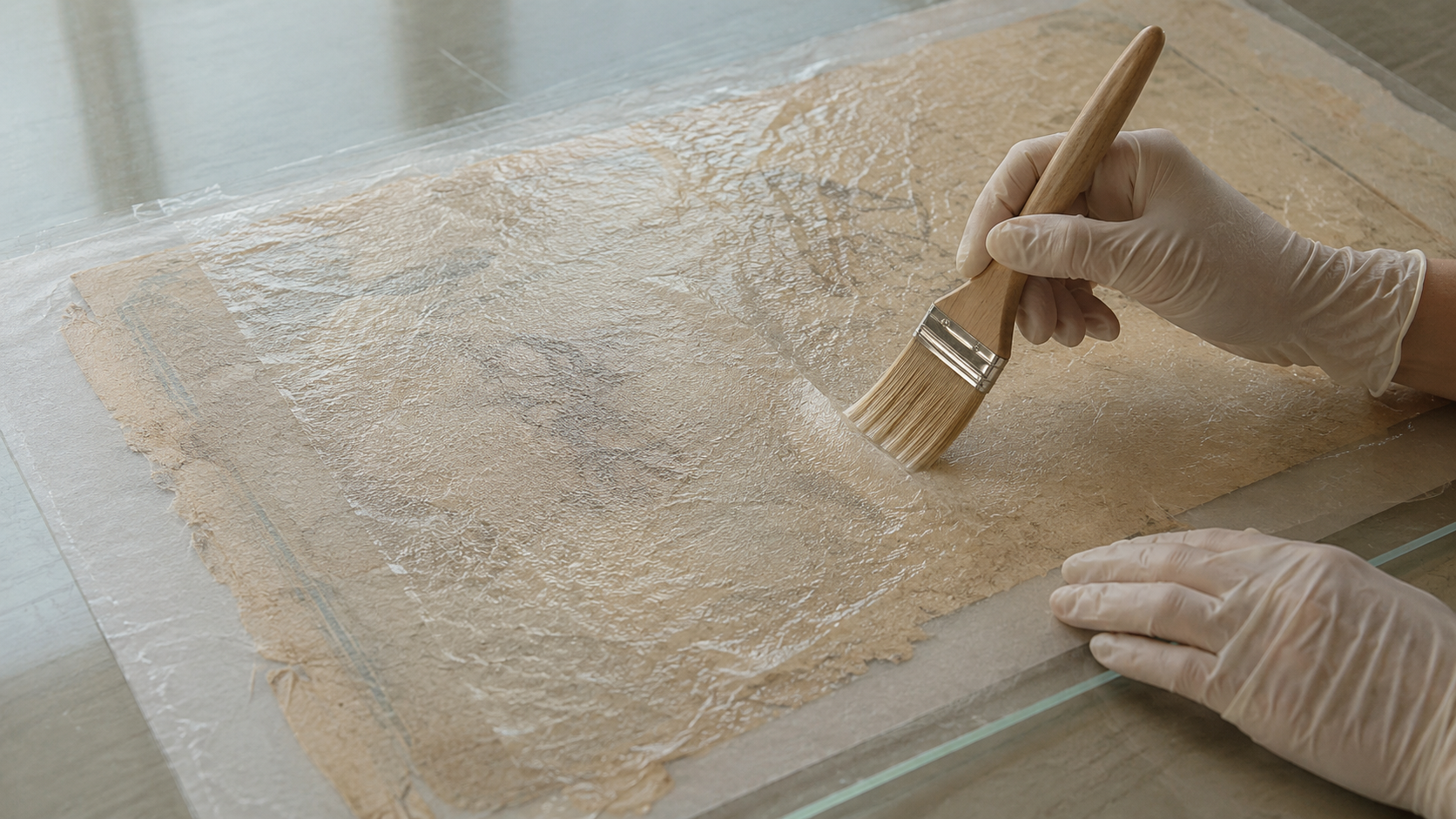
However, mass installations have their limitations and are not suitable for every type of collection. In conservation workshops, where work is carried out on single, often unique objects or sensitive works of art, an individualised approach is used. This requires the use of precise paper deacidification preparations, most often in the form of manual aerosols or liquids applied with a brush. In such cases, the paper conservator must carefully assess the risk – as studies show that introducing alkaline magnesium into sensitive pigments (e.g. in watercolours or pastels) can cause undesirable colorimetric shifts (changes in colour).
In the world of collectors and restoration enthusiasts, a harmful myth often persists: the belief that applying an deacidifying agent will restore a brittle card to its former flexibility and original strength.
From a physicochemical perspective, the deacidification process serves a purely stabilising, not reconstructive, role. The resulting alkaline reserve acts as a „chemical brake”.” – prevents further cracking of cellulose polymer bonds. However, technology cannot mend chains that have already broken. A document that crumbled in one's fingers before treatment will remain extremely brittle after deacidification. The only change will be that the rate of its further deterioration will be drastically reduced.
Therefore, for physically weakened paper stocks, simply neutralising acids is not enough. After the chemical process, physical consolidation and strengthening of the weakened sheets are necessary. Professional services are used for this. Tissue and Japanese papers (e.g., washi, kozo), which thanks to their long fibres create an invisible mesh reinforcing the structure of torn documents.
If your studio, company archive, or private collection contains items showing signs of acidification (characteristic yellowing of edges, brittleness), you must take appropriate preventative and remedial steps. To carry out basic protective treatments, you will need professional materials that comply with conservation standards: