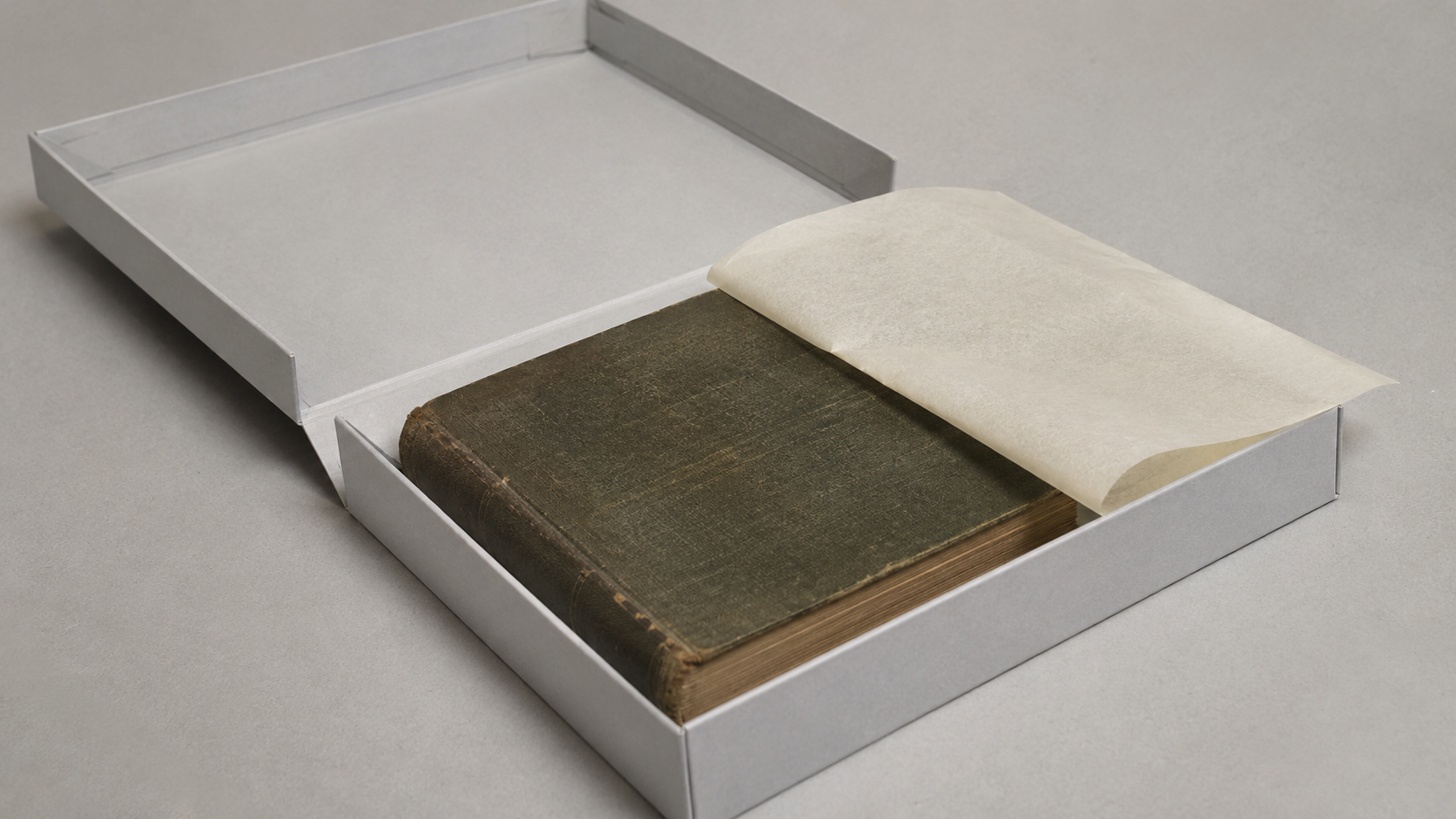

You pick up a 19th-century volume. The pages are alarmingly yellowed, and with the slightest attempt to turn a leaf, the edges crumble, leaving a dry dust on your fingers. This sight is all too familiar to any conservator, archivist or bookseller. It is the inevitable result of a phenomenon known in the trade as a „slow burn” (from the English ". Low heatTo protect valuable collections from it, acid-free paper is essential. Understanding its properties, chemistry, and the rigorous standards it must meet is the foundation of modern document preservation and restoration.
For centuries, paper was a material of remarkable durability. Until the mid-19th century, it was mainly produced from salvaged cotton and linen rags. The long, intact cellulose fibres mean that 500-year-old incunabula can be in far better condition today than books published just a few decades ago.
The crisis began during the Industrial Revolution. The demand for mass printing forced a search for cheaper raw materials, which led to wood pulp replacing cotton. However, wood contains lignin – a natural polymer that, during chemical and mechanical processing (e.g. bleaching), generates compounds of a strongly acidic nature. Additionally, historical methods of sealing paper and air pollution (such as sulphur dioxide) exacerbated the acidification.
The combination of acids and moisture from the surroundings initiates the process of acid hydrolysis. Put simply: Acids act like microscopic scissors, relentlessly cutting long cellulose chains into ever shorter fragments. This is an autocatalytic reaction, as further acids are produced during it, which further accelerate the decomposition. The effect? Drastic yellowing and extreme brittleness. pH measurements of prints from that period often indicate extremely dangerous levels of 3.0–4.0.
In a commercial context, these terms are sometimes used interchangeably, which is a significant and risky error. All archival paper is acid-free, but not all acid-free paper meets the rigorous standards for archival material.
The main principle is the removal of lignin and acids from wood pulp during the production stage, which allows for a neutral or slightly alkaline pH (from 7.0 to 9.0). However, simply neutralising the reaction is not enough. – paper, unprotected, would quickly absorb acids from its surroundings.
That's why to acid-free papers A so-called alkaline reserve (buffer) is added. This is most commonly calcium or magnesium carbonate, introduced at a minimum level of 0.4 mol/kg (often specified as a minimum content of 2%). For decades, this chemical buffer neutralises new acids penetrating the cellulose structure, ensuring mechanical and optical stability estimated to last several hundred years.
For material to be considered archival, it must meet far more extreme requirements. According to standards, wood is not used here at all. The raw material base consists of pure, long cotton, linen, or hemp fibres. These are characterised by immense resistance to bending and tearing. Such a medium of information, supported by a sufficient alkaline reserve, can survive in an intact state for up to 1000 years.
When choosing materials for renovation or archiving, it's not worth relying solely on manufacturers' claims. Top-class products are certified by international standards.
Determining the actual material condition of a document is the first step towards its preservation. In conservation laboratories, precise extraction methods and titration are used for this purpose (in accordance with, for example, Polish standards PN-84 P-50109). When dealing with priceless artefacts, a non-destructive contact method is used – by gently applying a drop of deionised water and placing the flat electrode of a pH meter against it.
For private collectors and restoration enthusiasts, the market offers more affordable, yet still reliable, solutions:
When acidification is detected, the destructive process itself can be halted, but unfortunately, the degradation of fibres that has already occurred cannot be reversed. The brittle side will remain brittle forever. The remedy lies in introducing a chemical buffer. At an institutional level, as with the long-term „Acid Paper” programme carried out by the National Library in Warsaw, mass deacidification installations are used. Technologies such as Bookkeeper are employed, which saturate thousands of volumes with alkaline magnesium carbonate nanoparticles in anhydrous solutions.
Liquids are not always safe. – they can blur historical inks or damage wax seals. In response to this risk, Polish specialists (including Dr. Tomasz Kozielec from Nicolaus Copernicus University in Toruń) are developing innovative „dry” alkalisation techniques, using electrostatics to introduce alkaline dust into the acidic cellulose network.
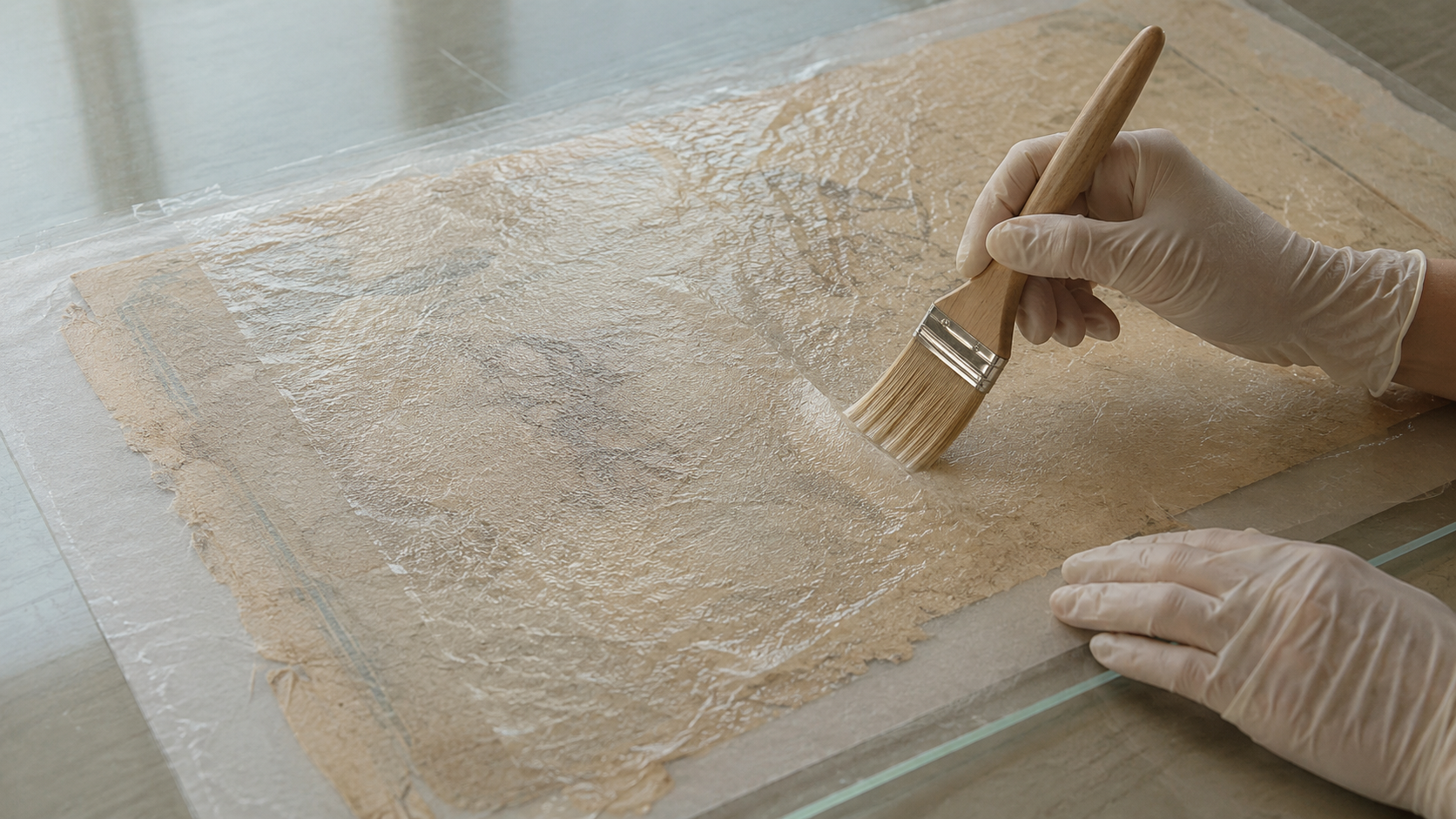
For smaller studios and bookbinders, saving individual sheets relies on manually applied preparations. High-end Paper deacidification materials, such as non-toxic buffering sprays, allow for safe pH raising and the introduction of magnesium carbonates to weakened sheets. Deacidified but weakened paper often needs to be physically strengthened by laminating it with delicate Japanese tissue or archival tapes.
Understanding the chemistry behind paper degradation translates into concrete decisions in a bookbinding workshop, archive, or during home graphic conservation. The use of inappropriate auxiliary materials is the most common reason for the loss of value in works of art. This phenomenon is called acid migration.
If you frame a valuable 19th-century print using cheap corrugated cardboard (rich in lignin) as the backing, the acid, influenced by natural moisture from the air, will quickly migrate to the valuable artwork, causing so-called acid burns (brown stains visible over time on the reverse).
Your workshop should contain the following to protect and repair collections according to best practice: