Restoring an old leather frame requires caution. The leather may be weakened by old tanning methods, contamination, light, humidity fluctuations, and previous repairs. Cleaning, gluing, or applying care products without identifying the material can cause discoloration, separation, or further cracking. With a valuable, fragile, or severely damaged book, it is safest to limit actions to proper storage and consult with a conservator regarding the scope of work. You can yourself vacuum the stable leather and store it well. The rest is left to the conservator.
Before you start cleaning or repairing anything, read the book without tearing your skin or opening it forcefully. Pay attention to:
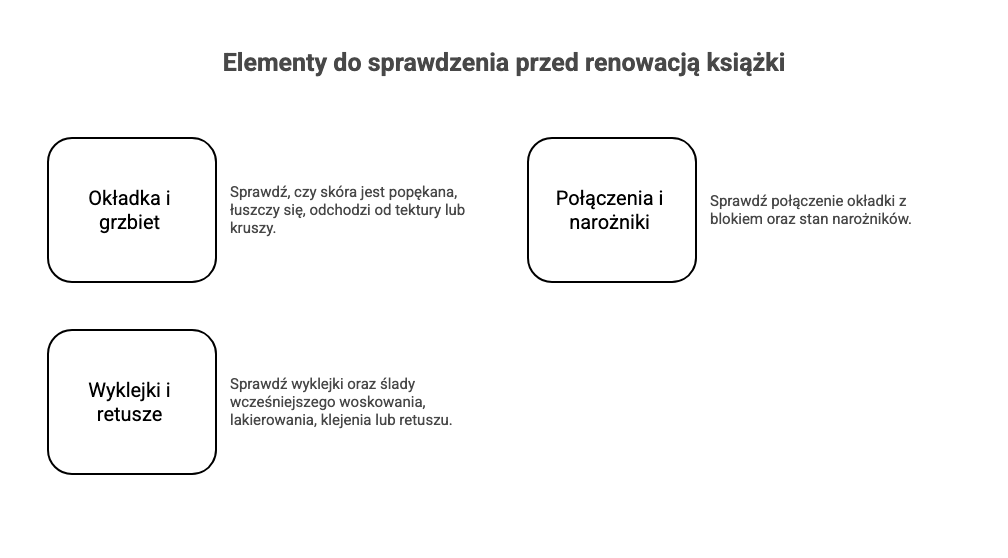
The old coating can change the appearance of the skin and its reaction to water or cleaning agents.
Do not rub the skin to see if it leaves a mark. With a weakened frame, such a test can detach additional fragments. The examination should be gentle, and the book should be supported during transport. If the hinge rattles, the cover comes off the block, the spine is loose, or pieces of skin fall off, do not open the book too wide and do not try to press on the parts. These are structural damage that may worsen with normal use.
With a stable and undamaged frame, you can carefully remove loose dust with a soft brush made from natural bristles, moving it from the back to the edges. Do not press the brush or apply this procedure to skin that is cracking, peeling, or flaking. Loose fragments can be removed even by gentle cleaning. In case of doubt, leave the surface unchanged.
When cleaning historical leather:
A severely soiled, greasy, or covered with an unknown layer of cover should be evaluated by a conservator. Do the same if you see a mold-like deposit. Do not brush it dry or spray the book with a biocide. First, limit contact with other objects and consult a safe method of handling. Mold can threaten both the object and the people who clean it.
Red rot is an advanced degradation that occurs primarily in some old leaves of plants that have been preserved in the ground. The leaves become weak and brittle, and reddish or brown dust appears on their surface. The problem often affects the spine and joints, that is, places prone to bending. The phenomenon is associated with acidic pollutants and the composition of the leaves; it is not simply a sign that they need to be „moistened”.
Red rot weakens the structure of the skin and favors further damage. It cannot be restored by overcoating the damaged fibers with a primer. The conservator may consider consolidation, a treatment that reduces surface peeling, but selects the product and method for the specific object.
In conservation literature, materials based on hydroxypropylcellulose are described, such as Klucel G or Cellugel. However, these are not universal self-applied products: the solvent, concentration, and method of application all have an impact on the appearance and durability of the skin.
Until consultation with the conservator:
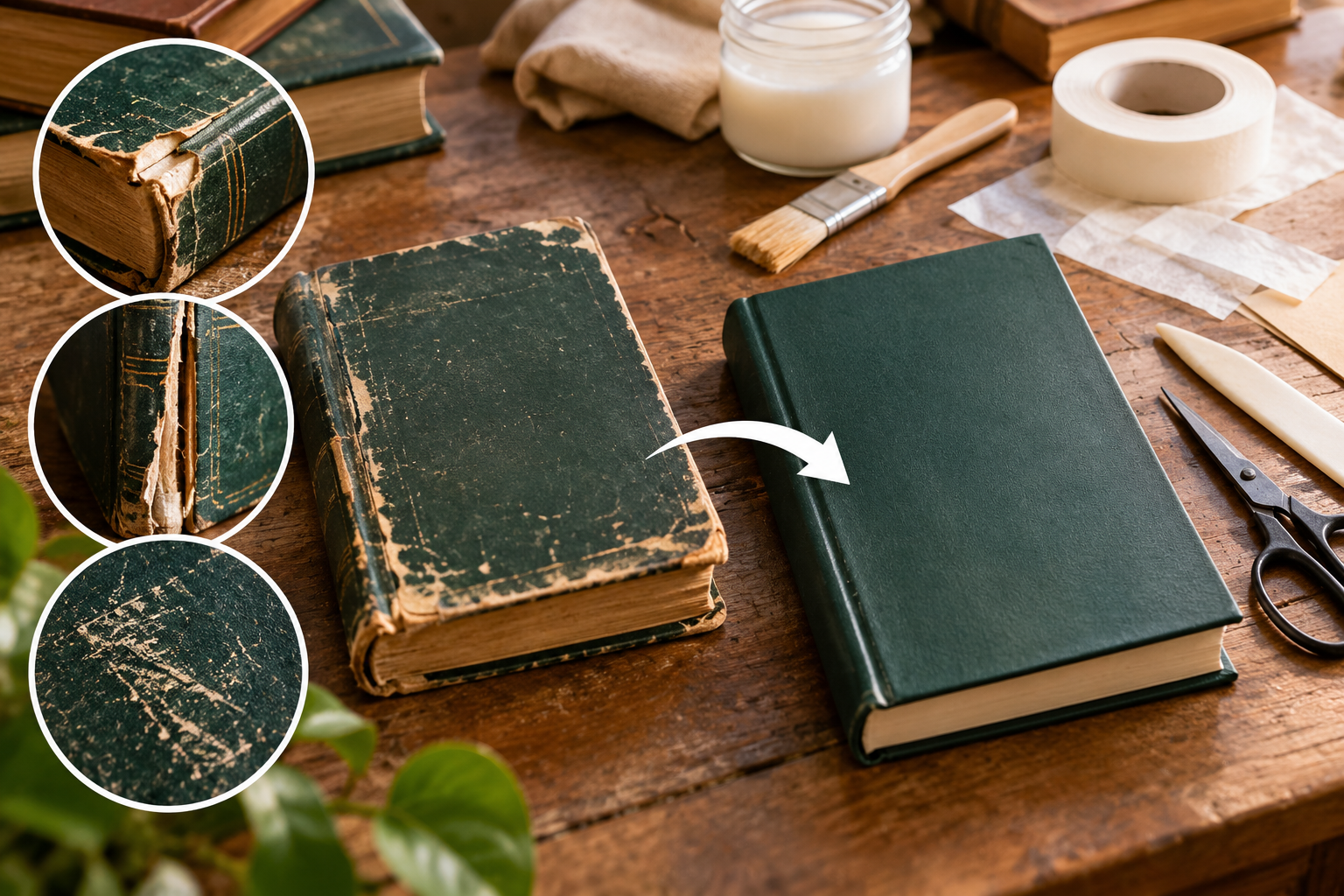
Cracks often appear on the back, at the hinges and at the corners. Disconnection means that the skin separates from the cardboard backing or another layer of the frame. Although such damage may appear minor, the glue introduced into the gap can seep onto the surface, leave a stain, stiffen the skin or attach it in the wrong position.
Do not fill cracks with PVA glue, universal glue, or Paraloid B-72 without a conservation assessment. The choice of adhesive depends on the type of leather, previous adhesives, the structure of the book, and the purpose of the repair. Not all adhesives are reversible in practice, and some products used in modern conservation may hinder future work. Leave valuable or fragile frames unadhesively and show them to a specialist.
If the leather tears, do not bend it to get to the bottom. Do not press it with a weight or clip without a backing and proper support. With a sharp bend or a broken fragment, further handling can lead to loss of material. Until repairs are made, limit use of the book and store it in a box that supports the cover.
The hinge connects the cover to the spine and transfers stress during opening. When the connection is loose, torn, or completely severed, the problem affects the book’s construction rather than just the surface of the skin. Repair may require identifying the way the cover is assembled, the condition of the stickers and the elements connecting the block to the cover. The introduction of the adhesive into the gap itself does not always strengthen the connection.
Until the hinge is repaired:
In the case of a complete detachment of the cover or a crack in the skin at the hinge, an individual repair is required. The process depends on the construction and value of the book.
If you can’t immediately send the book to be repaired, don’t try to restore its functionality by force. Limit opening, attaching the block and the cover while moving it, and store the book horizontally in a well-fitting box when loose parts prevent it from standing securely.
The damage revealing the fabric, canvas or paper can be supplemented with leather or other material chosen for the construction of the frame. The conservator takes into account the thickness and texture of the material, the finishing method and whether the new element is intended to serve a protective, structural or mainly aesthetic function. In some cases, it is more appropriate to protect the damage than to mask it.
Before deciding on a restoration, it is worth determining whether it should be visible as a contemporary repair or resemble its surroundings in appearance. In conservation, it is not always the goal to completely conceal the traces of the repair. What is more important is that the new material does not destroy the original and does not hinder future work. With books of historical, collector's, or sentimental value, do not cut the flap and do not sand the edges yourself.
The safest way to care for your skin is to reduce the factors that weaken it. Store your book in conditions with a stable humidity and temperature, away from a heater, a damp basement, direct sunlight, and sudden changes in climate. The Canadian Conservation Institute (CCI) recommends a stable humidity of 45-55% and a temperature of 18-22°C for leather. What matters more than exact numbers is that the conditions do not change.
Do not apply balm, oil, or wax regularly. Current conservation recommendations discourage the routine use of dressings on historic skins. Over time, they can stiffen the material, darken it, leave deposits, attract dust, or stain adjacent elements. The product recommended for new skin may not be suitable for old frames, and the very dryness to the touch does not indicate a need for lubrication.
No. Water and detergents can damage dyes, coatings, and adhesives.
From stable, undamaged skin, you can gently remove dust with a soft brush made of natural bristles.
This is a skin degradation that becomes weak and flaccid, and reddish or brown dust appears on its surface.
It is not worth doing this without the conservator's approval. The glue may leave a stain, stiffen the skin, or make future repairs more difficult.
Limit opening the book, prop it up while moving it, and consult a repair expert.
Keep it away from heaters, moisture, direct sunlight, and sudden changes in temperature and humidity.