Have you found a beautifully bound but heavily dried-out leather-bound book in an antique shop? Or perhaps a family Bible is starting to lose its former glory and you're wondering how to restore it to its former splendour? The first thought of many old book lovers is to reach for whatever they have in their cupboard: shoe polish, pure beeswax, or a conditioning oil. Unfortunately, this is a quick way to ruin the binding.
The leather on book bindings requires a completely different approach than a leather jacket, saddle, or winter boots. In this article, we'll explain why popular household remedies can harm your bookshelf and guide you on how to wisely choose the right product to restore antique books to their former glory without the risk of damage.
To understand how to care for an old binding, we first need to look at the leather itself. Bookbinding uses leather that is much thinner and more delicate than that used in the footwear industry. Furthermore, old tanning techniques mean that the leather on books reacts very severely to any domestic „treatments”.
The most common faults and damage include:
Therefore, when caring for a home archive, we always look for very gentle preparations, free from silicone, aggressive solvents, and artificial colourings.
In homemade renovation recipes, two magic ingredients often appear: beeswax and lanolin. Although both are completely natural, using them in their „pure” form is a big risk.
Wax perfectly protects against moisture and gives leather bindings that desirable, satin sheen without feeling sticky. However, applying pure wax to a thin cover is very difficult. It is incredibly easy to overdo it, creating a hard, crusty layer. Over time, such a coating will stiffen the most delicate part of the book. – its spine, which drastically speeds up cracking when browsing pages.
Lanolin is sheep's wool grease with a waxy texture. Its moisturising and softening properties are invaluable. Unfortunately, when applied on its own, it is far too heavy and intense for thin bookbinding covers. Pure lanolin can instantly make the leather greasy, leading to irreversible waves and dark stains. In extreme cases, the oil can penetrate directly into the paper, destroying the content of the book.
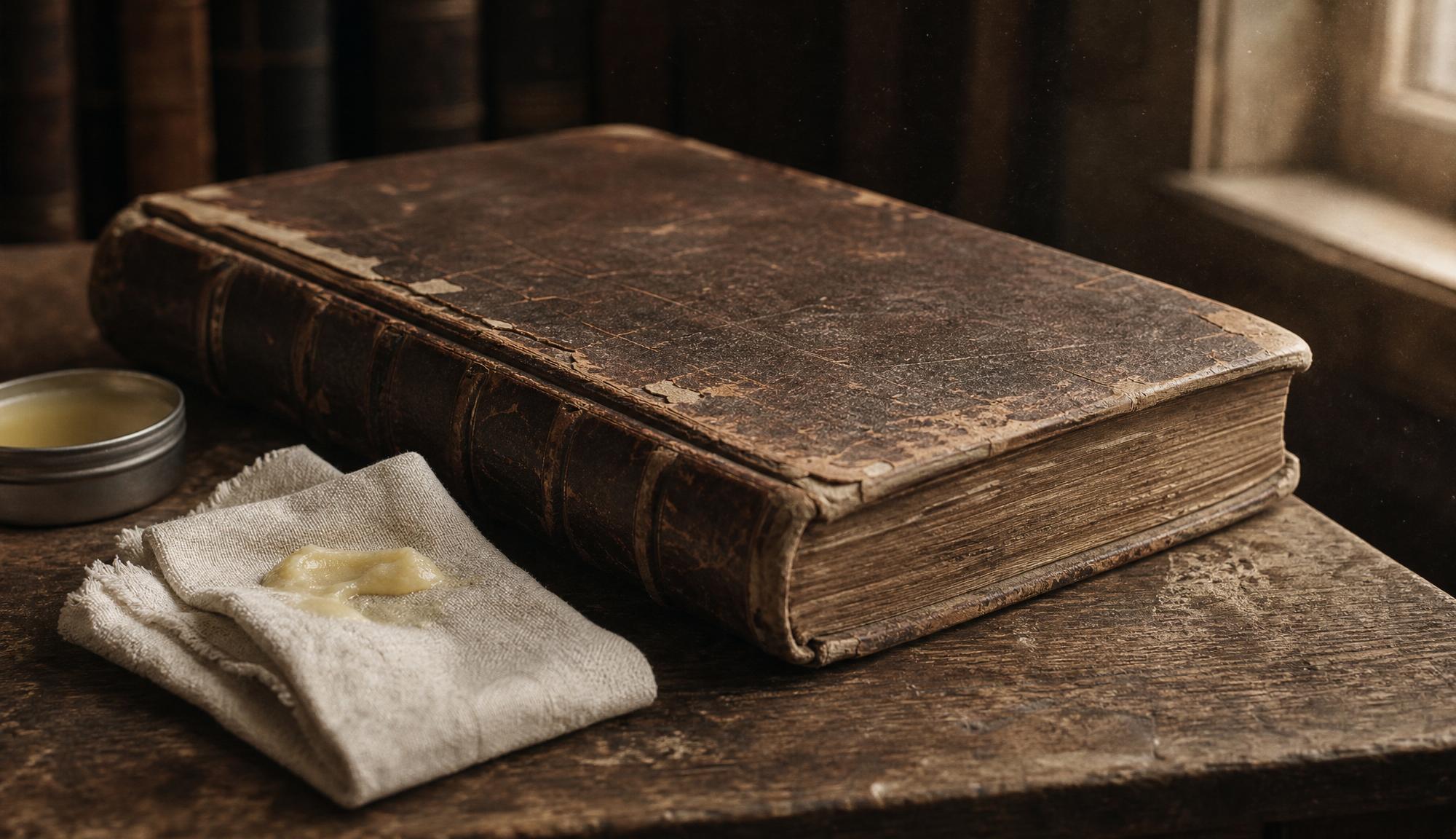
Instead of experimenting with semi-finished products, it is best to use a special balm for home renovation. It is a safe, ready-made mixture, in which you will find both beeswax (for protection and shine) and lanolin and natural oils (for moisturising and softening), but in perfectly balanced, light proportions.
A good balm regenerates and renews the skin's colour, leaving the pores open so the binding can „breathe”. When choosing a product for your collection, look for items described as dedicated „for smooth leather” or „for leather goods,” ensuring they do not contain dyes or chemical solvents. Conversely, avoid „heavy-duty” preparations (for saddles or trekking footwear) – they are far too strong for old books.
Skincare isn't difficult if you follow a simple, safe principle: „less is more.”.
How often should this treatment be repeated? In a home bookshelf protected from harsh sunlight, it's enough to do it once every few years. More frequent conditioning is only necessary if the books are kept in a particularly dry or heavily sunlit room.
For safe care of bookbinding covers, you don't need complex chemical tools. Your home kit should include: