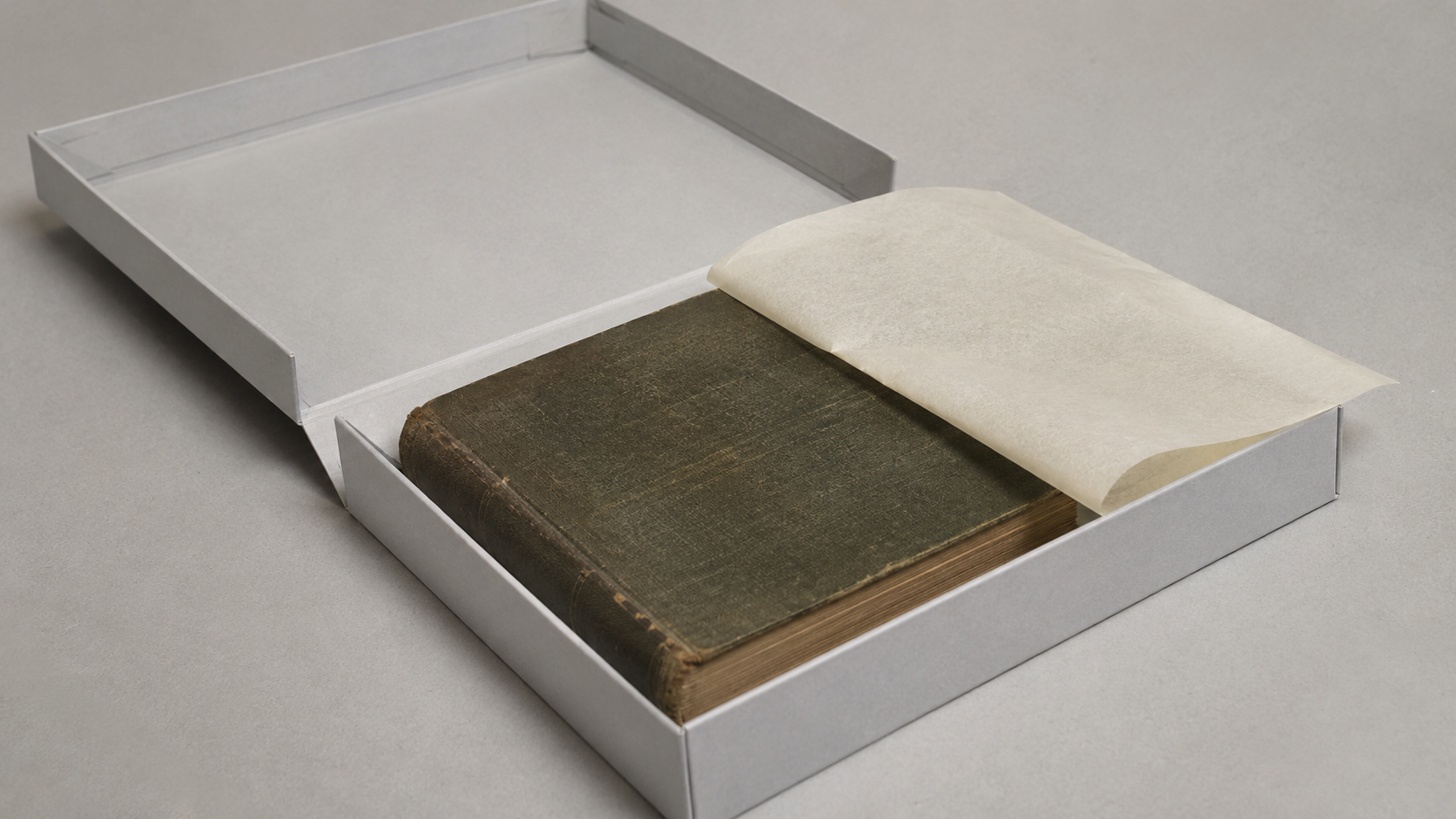

In the conservation and archival field, the phenomenon of paper degradation is sometimes referred to as a „slow fire”. Estimates published as part of the Multiannual Government Programme „Acidic Paper”, implemented by the National Library, are alarming: As many as 90% publications produced in Poland in the 19th and 20th centuries were printed on acid paper.
The yellowing of pages and their increasing brittleness are not solely natural, inevitable signs of material „ageing”. These are measurable, physicochemical chain processes that can be slowed down, and in many cases, entirely halted. However, to effectively protect collections – whether you’re managing a state archive warehouse or saving your home collection of old prints, you need to understand exactly what’s destroying paper from the inside.
The disintegration of paper is strictly dependent on the structure of its macromolecules and the substances used in the processing of wood pulp in the paper mill. The two primary mechanisms responsible for degradation are acid hydrolysis and lignin oxidation.
The primary structural component of paper is cellulose – a natural biopolymer whose long chains provide sheets with flexibility and tensile strength. When the bonds between the molecules in these chains break, the polymer fragments, and the paper begins to crumble. This process causes a phenomenon called acid hydrolysis.
Why is there acid in paper at all? The main historical reason is the Industrial Revolution. In the mid-19th century, a new, cheaper mass-production technique was introduced – sizing paper in the mass using alum-rosin glue. Alum (aluminium sulphate), in contact with the natural moisture from the air, releases sulfuric acid. What's worse, this process is autocatalytic, meaning it drives its own course, producing further destructive acids (acetic and formic).
While acids are responsible for brittleness, lignin is responsible for the characteristic rusty-brown hue of old documents. It is a complex organic polymer that naturally stiffens wood tissues. Unlike pure cellulose, lignin is extremely sensitive to light (especially UV radiation) and oxygen.
Under the influence of light, photoactive lignin molecules transform into transient radical structures. The end product of this reaction is substances that strongly absorb visible light, giving paper an unnatural, yellow hue. This reaction, called photooxidation, proceeds much more rapidly if the paper is already acidic.
It is also worth mentioning metallic contaminants. Iron and copper ions, often originating from historical inks (e.g. iron gall inks), in the presence of moisture can catalyse the formation of destructive free radicals, which directly attack and cleave cellulose chains.
Even the most degraded historical paper can be saved by providing it with a suitable microclimate. Canadian conservation expert, Stefan Michalski, using the Arrhenius equation as his basis, popularised an extremely vivid principle in the archival world: Each reduction in storage temperature of 5°C leads to a doubling in the rate of paper degradation reactions..
This means that moving the collections from a room at 20°C to a storage area that is just five degrees cooler doubles the expected lifespan of the collection. Conversely, an increase in relative humidity of 20% can almost double the rate of acid degradation.
Modern standard ISO 11799:2024, which sets out the principles for the storage of archival and library materials, now moves away from the artificial, energy-intensive maintenance of ideal conditions (e.g. a strict 18°C and 50% humidity level) using air conditioning. Instead, the standards promote the passive stability of buildings (the use of thick walls and insulation), allowing for slow, natural seasonal fluctuations whilst eliminating sudden daily temperature spikes that are harmful to cellulose. This standard also categorically rules out artificial lighting – UV radiation must be absolutely filtered out, and the maximum permissible lighting emission cannot exceed 75 µW/lm.
Since the acidification process is internal and progressive, it has become necessary to implement mass procedures for large book collections. Institutions such as the National Library are successfully using advanced deacidification technologies.
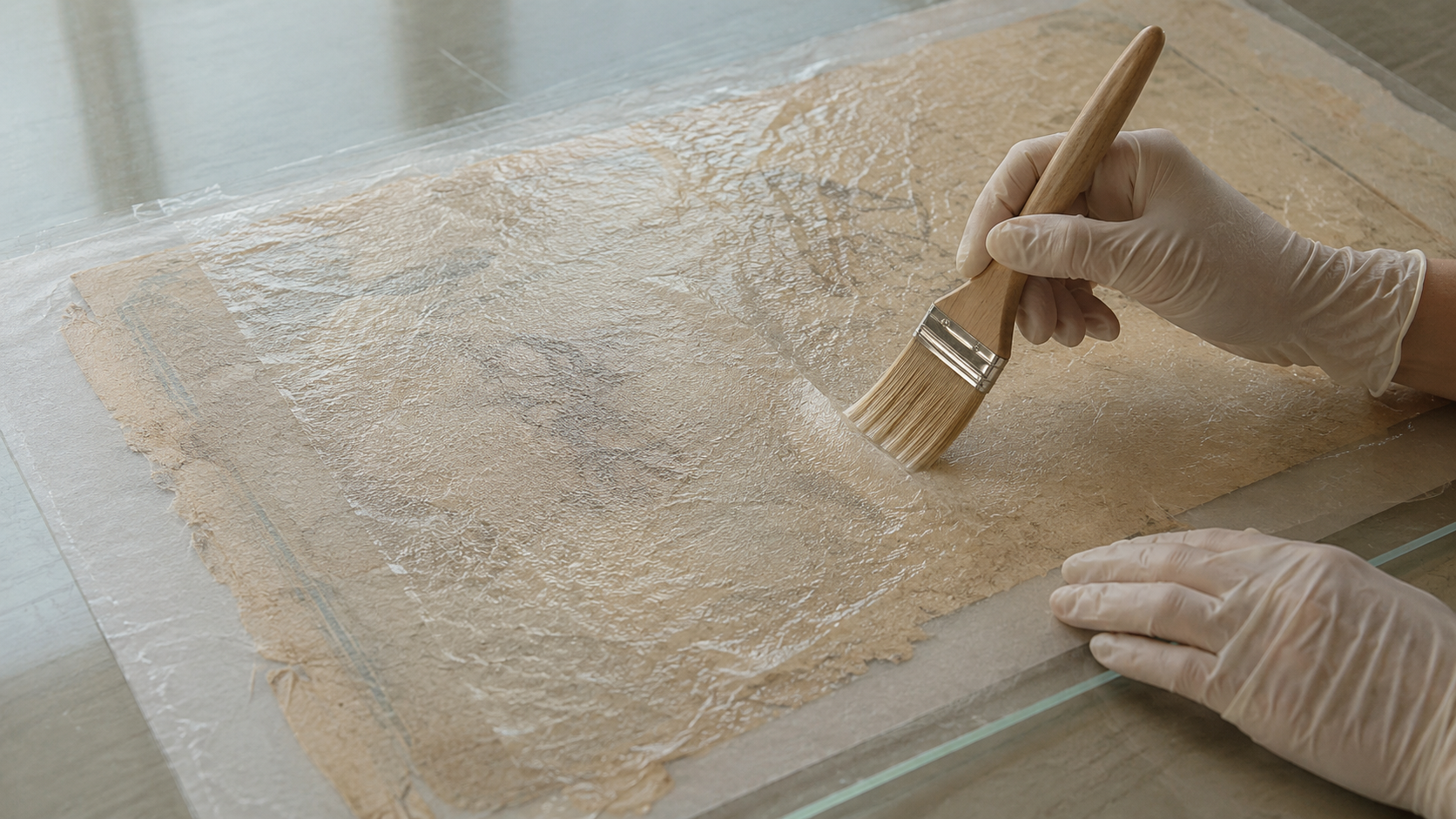
For delicate sheets of paper or maps, aqueous chambers are often used (e.g. systems based on Neschen solutions), where the substrate is saturated with alkaline magnesium bicarbonate. In the treatment of bound volumes, whose historical adhesives would be destroyed in water, Bookkeeper technology is used – an anhydrous dispersion of magnesium oxide. These treatments safely introduce an alkaline reserve into the paper, which neutralises the destructive action of acids for decades. However, one thing must be remembered: The deacidification process halts chemical degradation but does not reverse existing mechanical damage. Once broken cellulose fibres will not re-bond without the physical intervention of a conservator.
Whether you're a hobbyist restorer or run a professional workshop, there are a number of preventative and repair measures you can take yourself, using tried-and-tested professional materials.
To effectively protect paper, prepare your workshop: